

New Grad Nursing Resume Examples & Templates in 2026
Written by the Nurse Resume Builder Editorial Team.
Starting with a blank word doc to make your first nurse resume can be nerve wracking. But it isn't a bad thing, why? Because every nurse started from this very point.
Nursing is the United State's largest healthcare profession, with nearly 4.7 million registered nurses (RNs) nationwide, who started with no experience just like you.
And every Nurse out there knows the importance of a strong resume, one good resume can help you stand out from the competition. And to do this, we've gathered some pro tips and strategies for you one how to make a high impact new graduate nurse resume which brings interview invites to your inbox.
New grad nurse resume examples.
Minimal Template - Best for New Grads
Best template for new graduates and nurses with 1-3 years of experience.
 Use this template


What makes this template a perfect new grad nursing resume?
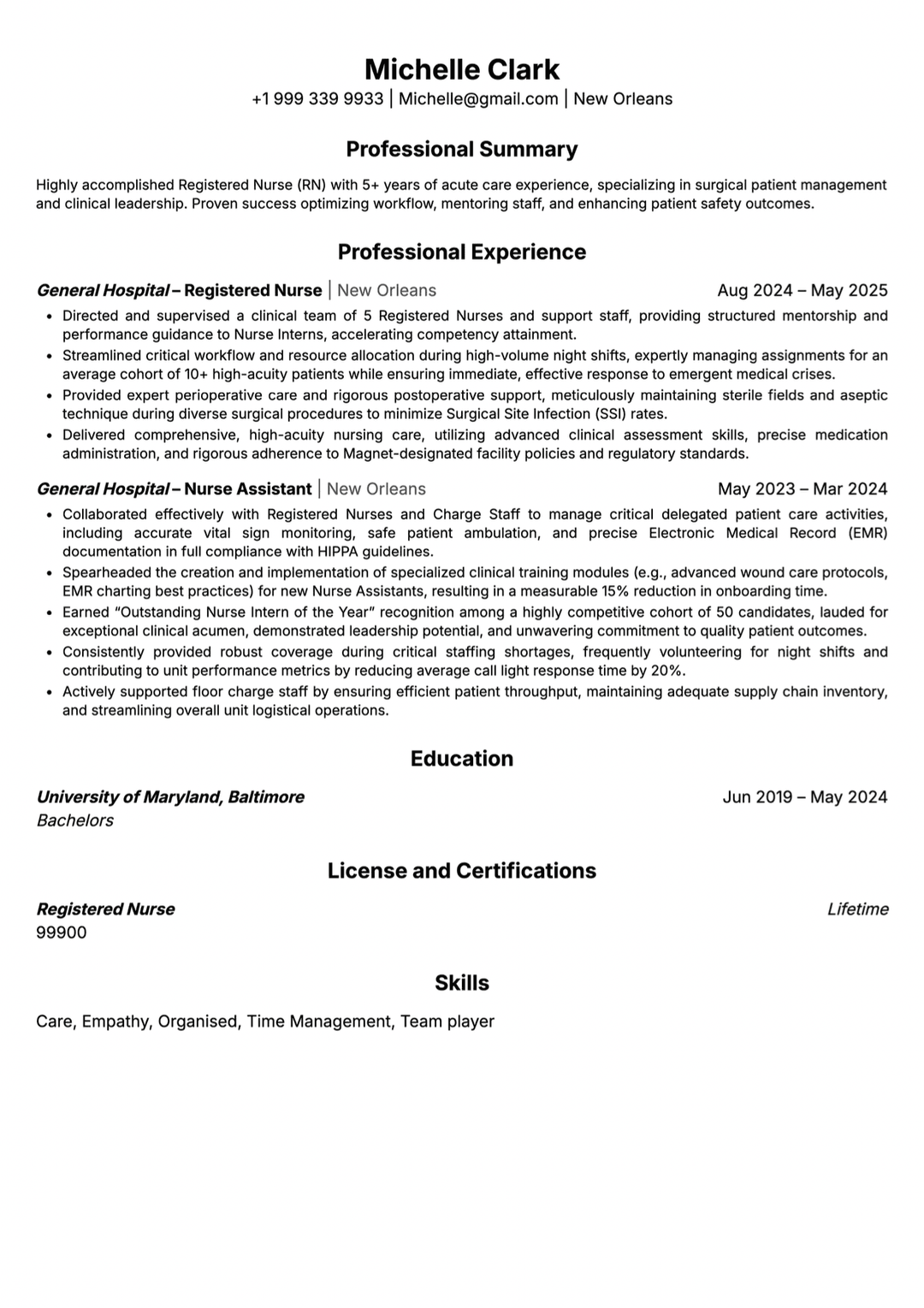
The use of summary highlights the candidate’s clinical experience and commitment to patient care. An education and license section demonstrates academic excellence and relevant license, which is extremely important to mention for a nurse resume. Professional clean format, easily readable and visually appealing.
Steps to make solid new grad nurse resume.
Step 1: Choose the Right Nurse Resume Template
Your resume is your first impression and your template comes before your content written in the resume.
Clean crisp template with proper white spacing, clean formatting gives solid first impression about the candidate, shows nurse manager that you are prepared. Being prepared is the key, that’s a bonus in your basket.
As the Director of HR in one of the biggest hospital chains once told me - “Sometimes, something as small as a messy layout can bury a great candidate's potential.”
The most effective nurse resume template is with a reverse-chronological format.
Recommended structure for new grad nurse resume:
- Header (Name, credentials, location, contact info)
- Professional summary
- Licensure & certifications
- Clinical experience
- Education
- Skills (hard + soft)
Step 2: Write a Professional Summary (Not an Objective)
Your nurse resume summary is not just a short professional introduction, it is a glimpse of your personality, your ambition and your achievements.
Each nurse type has a different requirement for summary. It is best to avoid generic summary which can be found on google or chatgpt. As you have little real nurse experience, using generic summary can make your resume fall flat in front of your recruiter. Remember, it’s your first job but your recruiter has gone through 1000’s of such resumes and they know the usual stuff.
Here is an example of a good summary for a new grad RN:So, write your own and then you can use google to refine it.
Tip:Instead of stating what you “want,” show what you offer, with hint of your personality and goals.
Example Summary for a New Grad RN:
“Compassionate and detail-oriented Registered Nurse with a BSN degree and RN license. Skilled in patient assessment, care planning, and EHR documentation with strong interpersonal skills and a team player attitude. Seeking to contribute clinical skills and empathy to [Hospital/Clinic Name].”
Step 3: Highlight Your Education After Summary
Since you're a new grad, your nursing degree is your strongest asset.
Example:
- Bachelor of Science in Nursing (BSN) - XYZ University, 2024.
- Relevant Coursework: Medical-Surgical Nursing, Pharmacology, Pediatric Care.
- GPA (if 3.5+): Optional but recommended.
Step 4: Add Licenses and Certifications
License and certifications add credibility and weightage to your candidature. Make sure to include all important license and certification, including your state RN license number and expiration date. Clearly list dates associated with licenses, this is of utmost importance.
Since these are often "must-have" requirements for hospital HR, make them easy to find.
Example:
- Registered Nurse (RN), State of [X], License #12345
- Basic Life Support (BLS), American Heart Association
- Advanced Cardiovascular Life Support (ACLS)
Step 5: Showcase Clinical Experience
Even though it's unpaid, clinical rotations count as experience. Clinical rotations are a valuable asset for a new grad as it is the closest you have been (considering there is no other healthcare experience you have) to the real life nursing job. Nurse managers love to learn about your clinical experience and understand how you tackled the situations, how was your composure and what you learnt from it. Use them to demonstrate skills.
Almost 60% of nurse managers accept that their main focus during interview is the clinical rotations, and they invest most of the interview time in understanding a new grad nurse's experience to understand how they might behave in the real life scenario.
Example:
Clinical Rotation - Pediatric Care | XYZ Children's Hospital, Spring 2024
- Completed 120+ supervised hours in pediatric ward.
- Performed patient assessments, administered medications, and documented vitals.
- Collaborated with physicians and nurses to deliver patient-centered care.
Step 6: Add Transferable Skills
Nursing is not like coding, in that you can sit in front of a computer and do your nerdy technical stuff and complete the cycle of communication by just one email. Hiring nurse managers look for interpersonal skills, they would like to know how good you are at communicating things. Plus technical and key skills in nursing is a must. So you better up your game in hard and soft skills.
Hard Skills:
- Patient assessment.
- Medication administration.
- Electronic Health Records (EHR).
- IV therapy.
Soft Skills:
- Empathy and communication.
- Team collaboration.
- Time management.
- Critical thinking.
Step 7: Include Volunteer Work or Part-Time Healthcare Roles
If you’ve worked as a CNA, caregiver, or medical assistant, include it. Even volunteer roles in community health add credibility.
Think this way, the nurse manager is looking for a new grad whom they can mold and train. So include all the things which can make your application a bit better, one step at a time.
Why New Graduate Nurse Resumes Get Rejected?
When new graduate nurses submit resumes for job applications, one common mistake stands out: including work experience that is not relevant to the position you are seeking. This can detract from your overall qualifications and obscure the most pertinent experiences that align with the job you want.
For instance, consider a nurse whose clinical experience is predominantly in obstetrics (OB) applying for a step-down nursing position. Highlighting extensive OB experience may not effectively convey your suitability for a role in step-down. Instead, it’s crucial to tailor the resume to emphasize skills and experiences directly related to the desired position.
Things to avoid on your nurse resume
- Don't use out-of-date contact information - Always make sure your email address and phone number are correct before sending your resume. Almost 18% of nursing candidate gets no call in their first month of applying for new job only because they were not available one email or phone they mentioned over the resume.
- Don't use overly complex formatting and layouts - that can make your resume harder to read, and less scannable for Applicant Tracking Systems (ATS).
- Don't mention hobbies or interests unless relevant - unless they help you prove a skill required for the role, that you haven't included elsewhere.
- Don't use passive language - change phrases like 'the project was delivered' to sentences using strong active verbs.
- Don't use business language/clichés - It can make your resume appear clichéd and harder to read.
Tips for Writing a New Grad Nurse Resume With No Experience.
The U.S. Bureau of Labor Statistics (BLS) projects that there will be over 194,500 job openings for registered nurses annually through 2032. To hire some many nurse, hiring managers do not expect new graduate nurses to have paid hospital experience. What they do expect is proof that you can function safely, communicate effectively, and transition smoothly into a clinical role and can be trained by senior nurse without giving them a headache.
The key is reframing your nursing education as hands-on, job-relevant experience — without exaggeration or fluff.
Below are some pointers on how to do this correctly.
How to Use Clinical Rotations as Real Experience.
Clinical rotations are your primary work experience as a new graduate nurse — but only if they are presented correctly.
Instead of listing rotations like coursework, you should present them as structured clinical roles with responsibilities and outcomes.
Best Practices:
Add Clinical Rotation under Work Experience (not "Education Details")
- Don't forget to mention facility name in the title and other details in bullet points, so hiring nurse manager can easily understand you have written coursework clinical rotation under work experience.
- There is no harm in putting your best foot forward with confidence and transparency. Transparency is the key here.
List each rotation with:
- Unit type.
- Facility type (hospital, clinic, long-term care).
- Duration of the rotation.
- Key responsibilities.
Example (ATS-friendly):
- Medical-Surgical Clinical Rotation - Acute Care Hospital - Provided direct patient care to adult patients under RN supervision, including vital sign monitoring, medication administration, wound care, and documentation in electronic health records.
Why this works:
- ATS systems recognize unit names (Med-Surg, ICU, ER).
- Recruiters see real patient exposure, not classroom learning.
- You appear "job-ready," not "student-only".
How to Describe Preceptorships?(This Is Critical)
Preceptorships are one of the most underutilized assets on new grad resumes — yet they are often the closest equivalent to real employment.
You should always separate preceptorships from general rotations.
How to list them correctly:
- Add Preceptorship under Work Experience (not “Education Details”)
- Mention Preceptorship Experience clearly in the position title.
- Clearly name:
1. Unit
2. Facility type Length (hours or weeks)
3. Level of independence
What recruiters want to see:
- Increasing responsibility
- Independent task execution
- Real shift exposure
- RN collaboration
Example:
- Senior Nursing Preceptorship - Medical-Surgical Unit - Completed a 120-hour preceptorship working one-on-one with a registered nurse, managing a patient assignment, administering medications, coordinating care plans, and communicating with interdisciplinary teams.
Why this matters:
- Signals transition readiness
- Reduces perceived training burden
- Strongly improves interview chances
Many of your peers will simply mention “preceptorship completed”, missed opportunity it is.
How to List Simulation Labs? (Without Sounding Like a Student)
Simulation labs should never be listed as generic lab work. They should be framed as clinical decision-making environments.
Avoid:
- “Participated in simulation labs”
Instead, focus on:
- Scenarios
- Critical thinking
- Safety protocols
- Team communication
Correct approach:
- Include simulation experience only if it demonstrates:
- Emergency response
- Clinical judgment
- High-risk scenarios
Example:
- High-Fidelity Simulation Training — Participated in simulated clinical scenarios involving patient deterioration, medication administration, and emergency response, demonstrating critical thinking, prioritization, and adherence to patient safety protocols.
This reassures recruiters that:
- You've handled pressure scenarios
- You understand clinical workflow
- You've practiced safe decision-making
How to Show Patient Exposure? (Even Without Employment)
Recruiters care deeply about patient interaction, not job titles.
You should clearly show:
- Type of patients
- Care complexity
- Interaction level
Include:
- Patient populations (adult, pediatric, geriatric)
- Care settings (acute care, long-term care, outpatient)
- Interaction scope (direct care, observation, documentation)
Example phrasing:
- Comfort with patients
- Bedside readiness
- Human interaction skills (critical for nursing)
How to Quantify Learning Outcomes? (This Will Set you Apart from the Competition)
Resumes which never reach the hiring managers desk, irrespective of the industry, are the ones only with text and no quantification.
Mentioning numbers, metrics helps hiring managers understand how well you did and what was the impact.
New grads often say what they did, but not how well or how often.
You should quantify learning exposure, not results.
Use this instead:
- Length of shifts
- Frequency of tasks
- Number of patients
- Scope of responsibility
Good examples for your reference:
- Assisted in caring for up to 5 patients per shift in a fast-paced medical-surgical unit.
- Completed 300+ clinical hours across acute care, long-term care, and community health settings.
- Documented 70+ patient assessments and care plans using electronic health record systems.
Quantification:
- Makes your experience tangible
- Improves ATS keyword matching
- Helps hiring managers evaluate your performance
- Builds credibility without exaggeration
Key Takeaway for New Grad Nurses
Shift the mindset.
Stop thinking - I don’t have anything to write on my resume to impress the hiring manager. Instead start giving affirmation of confidence to yourself and believe.
If you are doubting yourself, then let me tell you - You do not lack skills or credentials, you lack presentation.
When written correctly:
- Clinical rotations = work experience
- Preceptorships = near-employment readiness
- Simulation labs = clinical judgment training
- Patient exposure = bedside competence
You will end up with a strong resume for a new grad nurse which will impress every hiring nurse manager out there.
Check here why our resume builder is the top among the top 5 resume builder for nurses.
Guide to making your resume ATS-friendly
Applicant Tracking Systems (ATS) is like Microsoft Excel, found in every HRs system these days.
ATS is the key way recruiters and employers manage the hiring process, the system can not only helps in managing the job posting, interview scheduling but screens candidates by scanning and ranking resumes based on each candidate's likely suitability for the vacancy.
When writing your new grad nurse resume, a few simple tips can help you pass the ATS stage with a higher-ranking resume, giving you a better chance of success with your applications.
Here are some tips to help you make your resume ATS-friendly:
- Opt for an established, traditional resume format such as a reverse-chronological or functional structure. These will ensure your resume includes all the necessary details ATS systems scan for.
- Include keywords throughout your resume that align with the job description. ATS software tends to compare your resume to the job description for points of similarity, so careful, right choice of keywords could get you your interview call.
- Add each section with clear headings that match the established resume conventions, so ATS software can easily identify each part of your resume.
- Adopt a resume design that uses clear, professional design principles and leaves white space for your content to breathe. Use the most readable fonts and incorporate subtle design elements to enhance the readability of your document.
- Use concise language to keep the length of your resume to between one and two pages. This will make it easier to scan for ATS applications.
ATS-optimized new grad nurse resume template.
Top Keywords to Include in Your Nursing Resume
Medical facility hiring managers may programme their applicant tracking systems to search for keywords relating to healthcare or nursing.
By including these keywords in your resume, you can increase the chances of your application passing a software's scan.
Here are some keywords to include in your resume:
Finding Keyword For A Nursing Resume
The best strategy to find keywords for your nurse resume is to borrow them from the job description you are applying for. I know it could be taxing to edit the resume every time when you find a new exciting positon.
But you can always make a list of keywords which are common in your field and sprinkle them all around. Additionally, you can find nursing keywords to include on your resume using a variety of other methods, including:
- Reviewing your own professional documents
- Researching the company
- Getting in touch with your nursing or medical network
Some Useful Nursing Resume Keywords
- Creative problem-solving
- Medical supply management
- Medication administration
- Medical procedure preparation
- Proficient in electronic medical records (EMR) systems and documentation
- Patient monitoring
- Medical screening
- Treatment preparation
- Patient Care
- Time Management
- Leadership
- Critical Thinking
- Hygiene
New Graduate Nurse Resume Summary (Examples)
Summary example 1:
Dedicated, empathetic and newly certified nurse with a remarkable academic record and experience from clinical placements. Possesses a strong understanding of patient care, infection control and medical terminology, honed through rigorous coursework and hands-on training. Looking forward to start my career in nursing and aiming to become a specialized nurse in the coming years.
Summary example 2:
Driven nursing graduate with a focus on holistic patient care, equipped with strong communication skills and a desire to learn, seeking to make a meaningful contribution to a healthcare facility.
Summary example 3:
New graduate nurse with a strong commitment to patient care and safety, equipped with essential nursing skills and a desire to collaborate with healthcare professionals for optimal patient outcomes.
Summary example 4:
Detail-oriented new graduate nurse with a strong foundation in patient assessment and care planning, committed to improving patient outcomes through evidence-based practices and effective communication with healthcare teams.
Summary example 5:
Compassionate new graduate nurse with experience in rehabilitation settings, dedicated to supporting patients in their recovery journey and promoting independence through personalized care and encouragement.
Summary example 6:
Dedicated new graduate nurse with a strong commitment to lifelong learning, eager to collaborate with seasoned professionals and contribute to a patient-centered approach in diverse healthcare environments.
Our best wishes for starting your nursing career.
At last, building a well-crafted new grad nursing resume is an essential step in starting your career. By including the right skills, showcasing relevant experiences, and utilizing great resume examples tailored to the field, you'll be better prepared to impress hiring managers.
Take the time to make your resume carefully, and soon enough, you'll be on your way to securing your first nursing job.
Ready to Build Your Perfect New Graduate Nurse Resume?
Need help? Contact our team for any support.