Registered Nurse (RN) Resume Guide for 2025
(Examples, Templates & Tips)

Richard Shelton
Resume writing expert.
Let's start with a light note.
What do you call a hospital that’s running out of maternity nurses? A mid-wife crisis. LOL. Now let's talk business.
The game has changed. AI will read resume before real human eyes.
- The Registered Nurse (RN) resume you used three years ago is no longer effective for today's job market.
- ✅ Hiring systems are highly automated.
- ✅ Competition for roles is tighter.
- ✅ Hospitals rely on AI-powered Applicant Tracking Systems (ATS) to filter candidates first.
- A Simple List of Duties is Insufficient:Your RN resume must go beyond merely listing your job responsibilities. New Resume Goal You need to translate your clinical expertise into a format that modern hiring systems (ATS) can instantly understand. This means focusing on:
- ✅ Keywords relevant to the role.
- ✅ Metrics (quantifiable achievements).
- ✅ Patient-Impact Statements (showing the positive results of your work).
The real struggle.
This is exactly where every nurse struggles; you're balancing 12-hour shifts, charting marathons, medication passes, rapid responses, family education, and potentially preceptor responsibilities—yet no one taught you how to write a resume that passes AI scanning robots. Sounds frustrating, right? But here is a good news — You've come to the right place. This guide breaks down everything needed to build a modern, professional, and ATS-perfect Registered Nurse resume that stands out in 2025.
Demand is high.
Let's take a step back and start with the big picture. The demand for RNs remains high, but the competition has become smarter, tougher and fierce. Recruiters now skim resumes in 6–7 seconds, and ATS systems rank applicants based on keyword matching, formatting, section placement, and clinical relevance. So if your nurse resume doesn't clearly highlight your RN license, certifications (like ACLS/BLS), clinical specialties, and measurable impact—think "reduced patient falls by 25%" or "managed a 5:1 patient ratio in high-acuity settings"—you're instantly pushed to the bottom of the pile.
Worry not, you have a saviour.
Why nurses trust NurseResumeBuilder.app.
- ✅ It automatically generates nurse-specific content, saving you time and effort.
- ✅ It suggests strong clinical bullet points, focusing on impact and results.
- ✅ It correctly incorporates relevant medical terminology and certifications.
- ✅ It ensures every section is optimized for AI-driven Applicant Tracking Systems (ATS).
- ✅ It is more accurate and relevant than general resume builders because it understands clinical language and nursing workflows.
- ✅ It is a trusted tool that has helped thousands of nurses (ICU, ER, Med-Surg, New Grads) create job-winning resumes.
Expert's choice:
Get your RN resume crafted in minutes.
Get AI-crafted summary and bullet points with professional resume templates.
What Is a Registered Nurse Resume? (And Why Employers Reject 70% of RN Applications)
Don't be shocked reading 70% rejection rate. *eye rolls* If you've ever watched a stack of nurse resumes pile up on a nurse manager's desk faster than a line forms at the medication dispensing machine during a shift change, then you already know: a Registered Nurse (RN) resume isn't just a document—it's a clinical survival tool. It's your professional chart, your first impression, and your handshake to the recruiter long before you ever scrub in, start an IV, or attempt to fix a malfunctioning vitals monitor that somehow only malfunctions when you're using it.
A Registered Nurse resume is essentially a targeted professional document detailing your RN license, relevant experience, core clinical competencies, and the quantifiable influence you've exerted on improving patient outcomes, it is important to include, while a CNA or LPN resume might emphasize foundational patient care and supportive tasks, the RN resume leans heavily into decision-making, critical thinking, and your role as the point-of-care lead. In other words, if the healthcare team is an orchestra, your CNA tunes the instruments, your LPN keeps the tempo steady, and you—the RN—keep the entire ensemble from falling apart when a rapid response is called during shift handoff. Please make a point regarding this.
A strong RN resume answers three questions instantly for the recruiter or hiring manager:
- Can you keep patients safe?
- Do you have the skills this unit actually needs?
- Are you capable of surviving a 12-hour shift without threatening to rename your unit "Mordor"?
Now let's talk about the critical obstacle in the hospital hallway: Why are 70% of RN applications dismissed before a human ever sees them? Because every major hospital system in 2025 uses ATS (Applicant Tracking Systems)—software that scans your resume like an automated gatekeeper with X-ray vision and zero patience. ATS filters look for explicit keywords from the job description, simple formatting, and structured sections. If your resume has fancy graphics, text boxes, or looks like it was decorated in Canva the night before, the system may not be able to read it. And if the ATS can't read it? Congratulations—you're invisible. Not ideal.
A proper resume for an RN job in today's hiring environment follows updated professional standards, meaning:
✔ A clean, ATS-friendly layout.
No columns, no icons, no cute nurse stethoscope graphics. Keep it simple. Keep it scannable. Think "ICU charting," not "Pinterest mood board."
✔ Clear section headings the ATS can recognize:
- Professional Summary or Objective (depending on experience)
- RN Licensure & Certifications (format: RN, State, License #, Exp.)
- Clinical Experience (yes, with measurable achievements—not just tasks)
- Key Skills (aligned with the job posting)
- Education
- Technical Skills (EHRs, equipment, software)
✔ Proper keyword placement
This is crucial. Your resume needs the actual terms employers are searching for, like:
- "Registered Nurse (RN)"
- "Telemetry experience"
- "Critical care"
- "Acute care"
- "EHR: Epic/Cerner/Meditech"
- "Medication administration"
- "Triage"
If the job description says "IV medication administration," your resume cannot say "IV meds admin." Close enough doesn't cut it in ATS-land.
✔ Achievements instead of duties
Every nurse has "provided patient care." Not every nurse has:
- "Reduced catheter-associated infections by 12% through improved sterile technique,"
- "Managed 5:1 patient ratios in a high-acuity med-surg unit,"
- "Precepted 8 new graduate nurses, improving onboarding efficiency."
Those are the bullets that get interviews. That's a common thought, but in reality, a Registered Nurse's resume should maintain a consistent professional format regardless of the unit—ICU, Med-Surg, ER, L&D, or Telemetry—because the foundational skills and core competencies are what recruiters look for first. The truth is, the structure stays the same—it's the content within those sections that shifts. Recruiters want familiarity, not creativity. They want to know exactly where to look for your licensure, how you phrase your competencies, and whether your experience aligns with the unit they're hiring for.
A Registered Nurse resume is your professional lifeline. Make it clean, make it clinical, and make it relevant—and you'll stand out in a hiring world that's more crowded and automated than ever.
Get your professional RN resume crafted in minutes.
Get AI-crafted summary and bullet points with professional resume templates.
Best RN Resume Examples for 2025
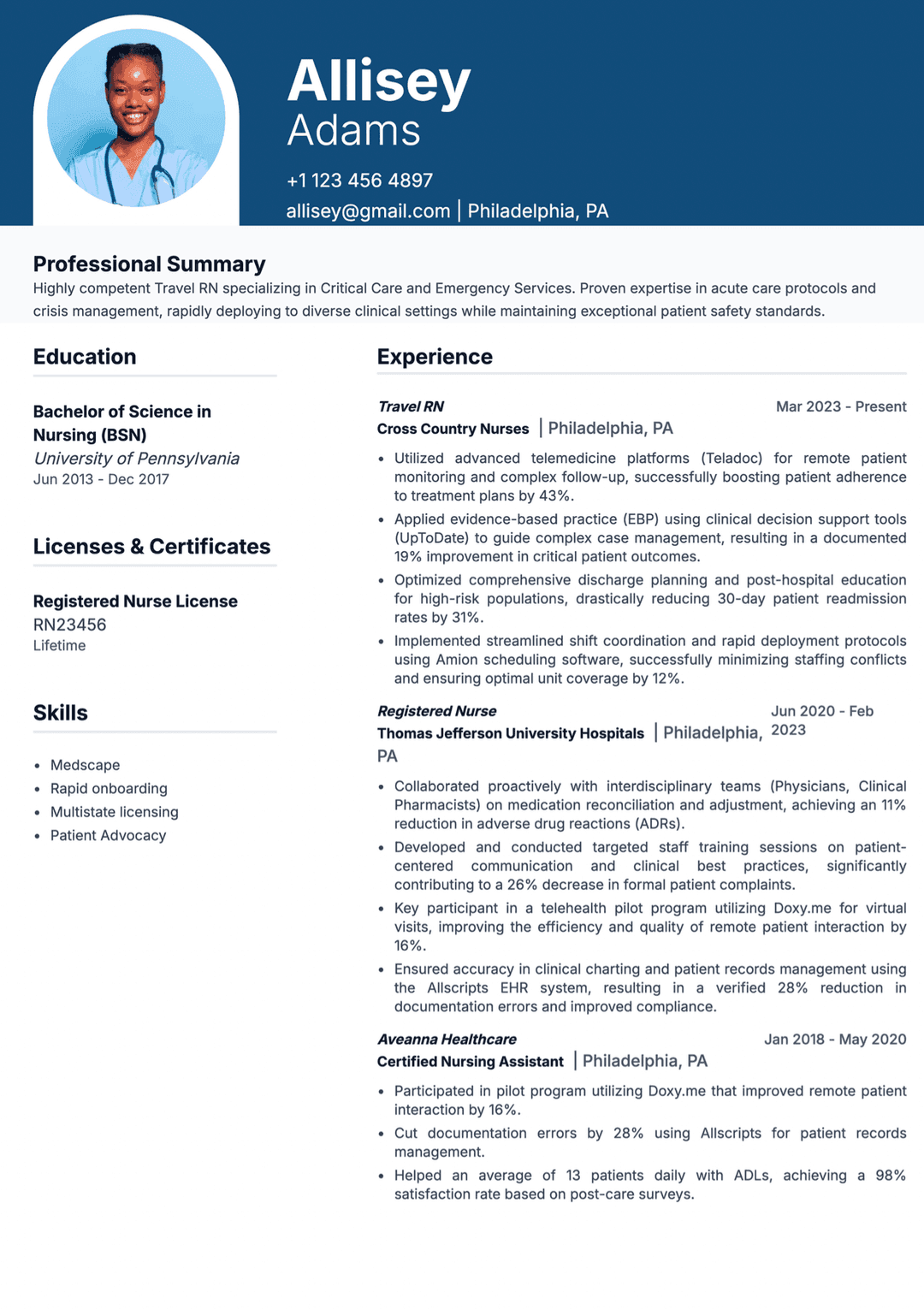
You would relate to this; If you've ever sat in a break room flipping through résumés for a charge nurse role and thought, "Wow… we are really sending this to HR?" — then you already know how much a clean, well-structured RN resume matters in 2025. The job market is competitive and hospitals are understaffed yet picky. This is the main reason, exactly why looking at strong Registered Nurse resume examples can save you from accidentally blending into the pile of "generic nurse #72." Below are a few polished, real-world RN resume examples that show you exactly what works today.

RN Resume Example 1 - Experienced RN
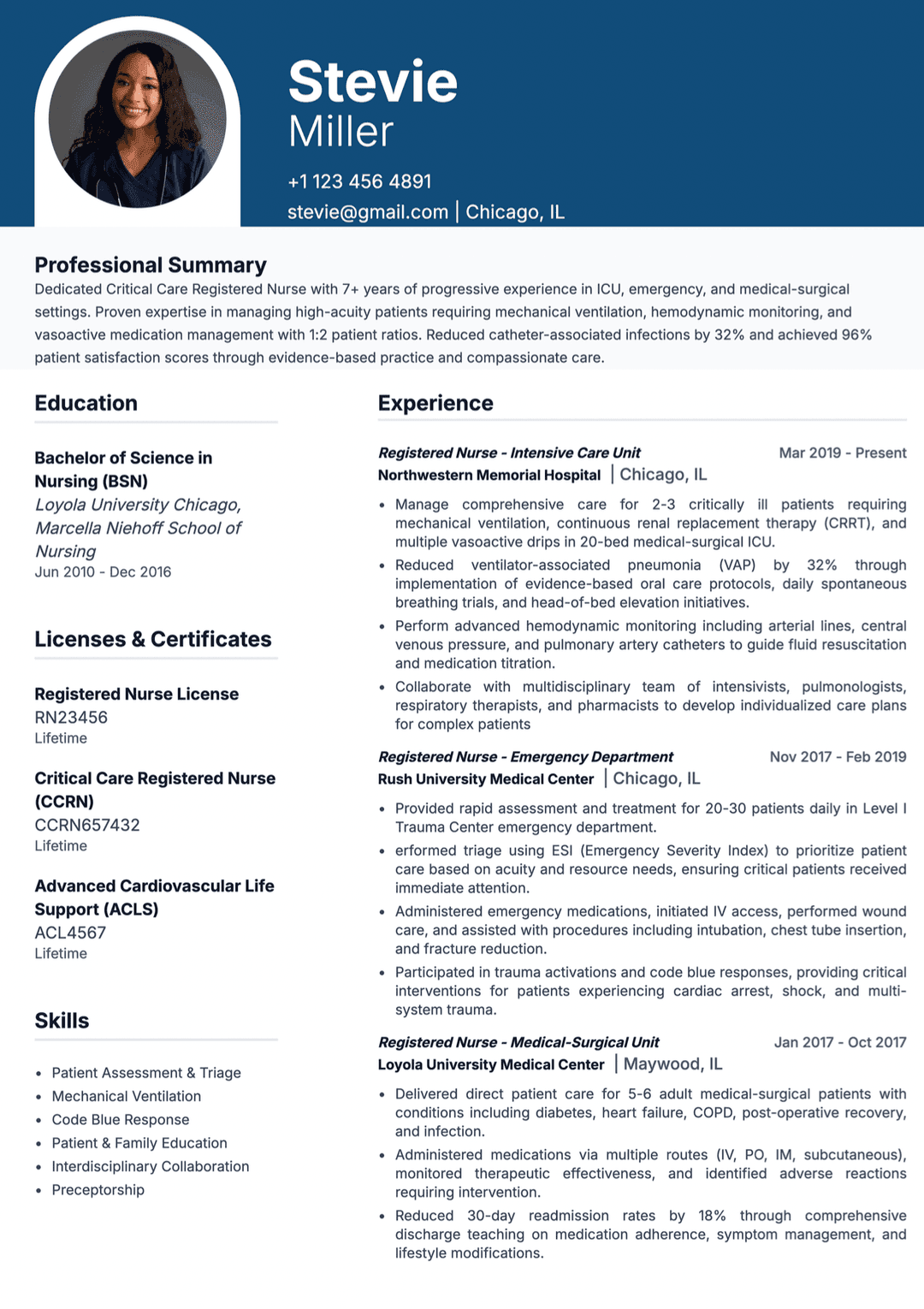
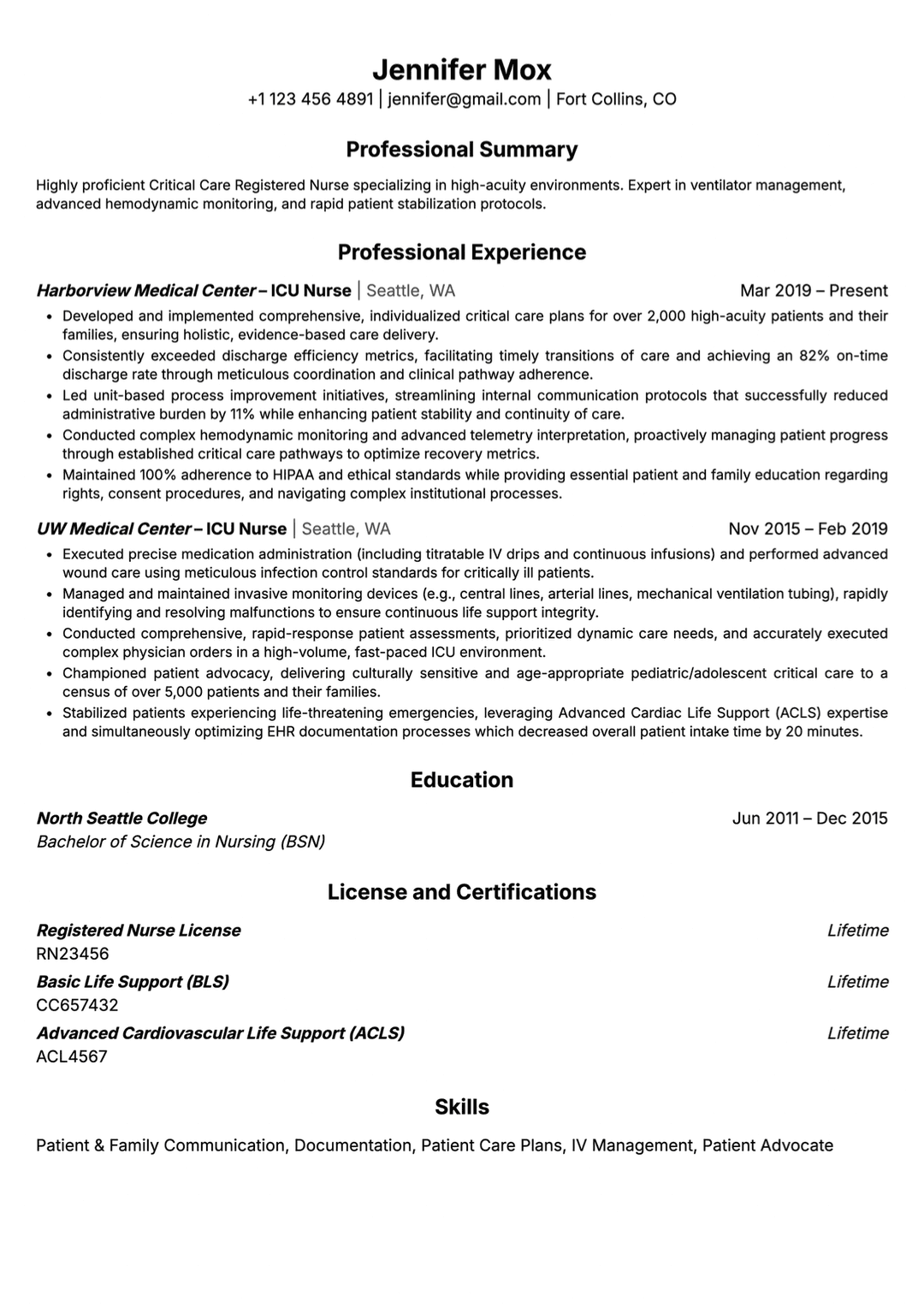
Experienced RN Resume Example, the one most hiring managers secretly hope they'll find. This template features a clean ATS-friendly layout, crisp section headers, and measurable achievements — not just the usual "provided patient care" fluff that recruiters glaze over. Instead, it highlights impact: medication error reduction, improved patient satisfaction, successful management of 5:1 ratios in high-acuity units, and documented efficiency improvements. The certifications are right where they should be (BLS, ACLS, NIHSS, PALS if relevant), and contact information is formatted simply enough that the ATS reads it without rolling its eyes. It also includes a skills section that actually reflects clinical competency rather than a copy-paste from a textbook. This example proves that seasoned nurses don't need to oversell — they just need to quantify their expertise and package it cleanly.

RN Resume Example 2 - New Grad RN
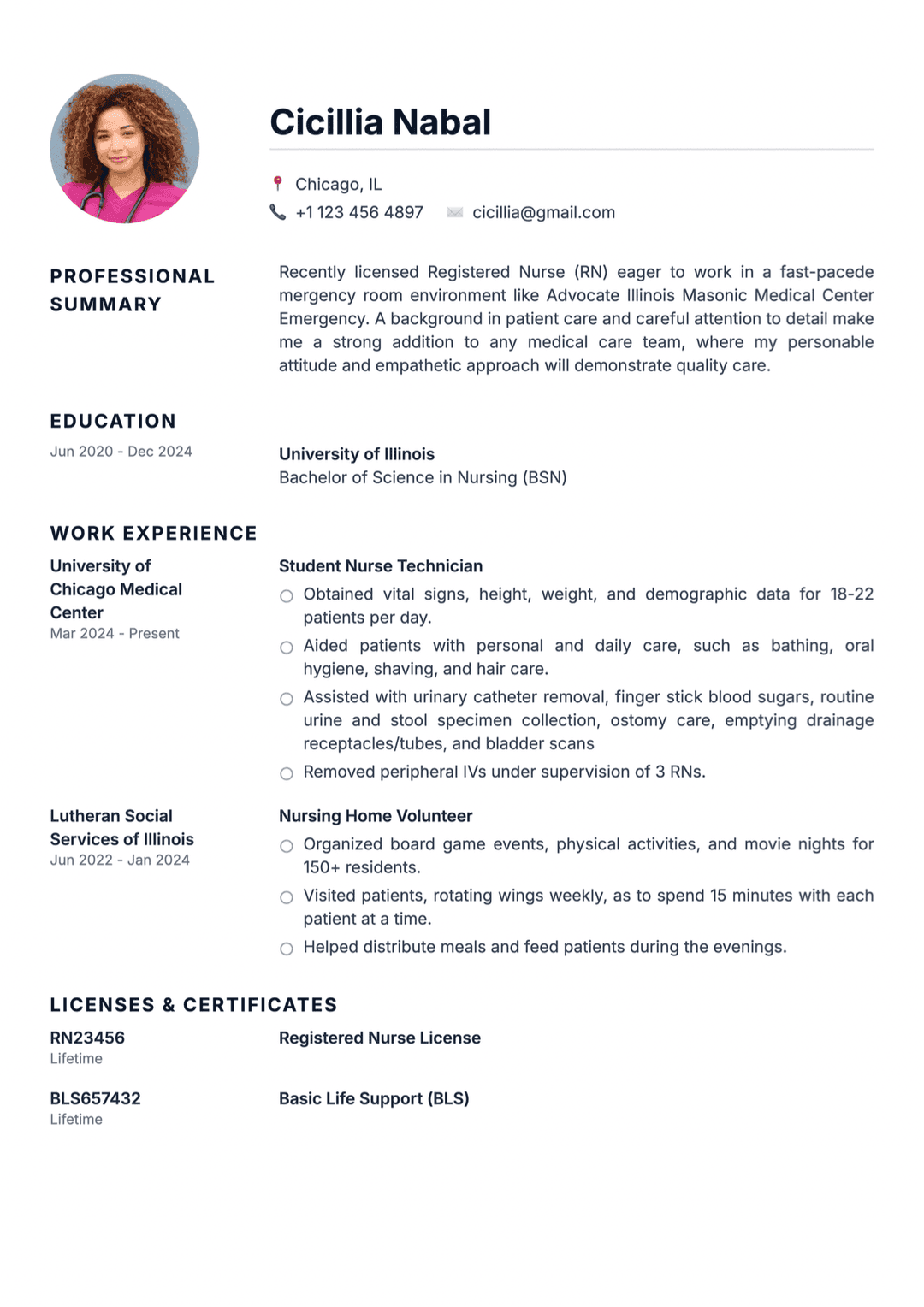
That New Grad RN Resume Example is your professional essential, like having your own quality stethoscope for your first hospital shift. When deep professional experience is minimal, the organization and structure of your resume becomes paramount. This template gives new grads room to shine by showcasing clinical rotations, preceptorships, hands-on skills, and even indicators of professionalism (like volunteer work or leadership roles in nursing school). It includes well-written objective statements — yes, new grads should use objectives — that show motivation, clarity, and readiness to learn. The bullet points under each clinical rotation demonstrate actual responsibilities ("performed head-to-toe assessments," "supported wound care for 20+ patients weekly," "assisted in implementing fall-prevention protocols"), showing recruiters that you're not just fresh, but functional.

RN Resume Example 3 - Specialized RN
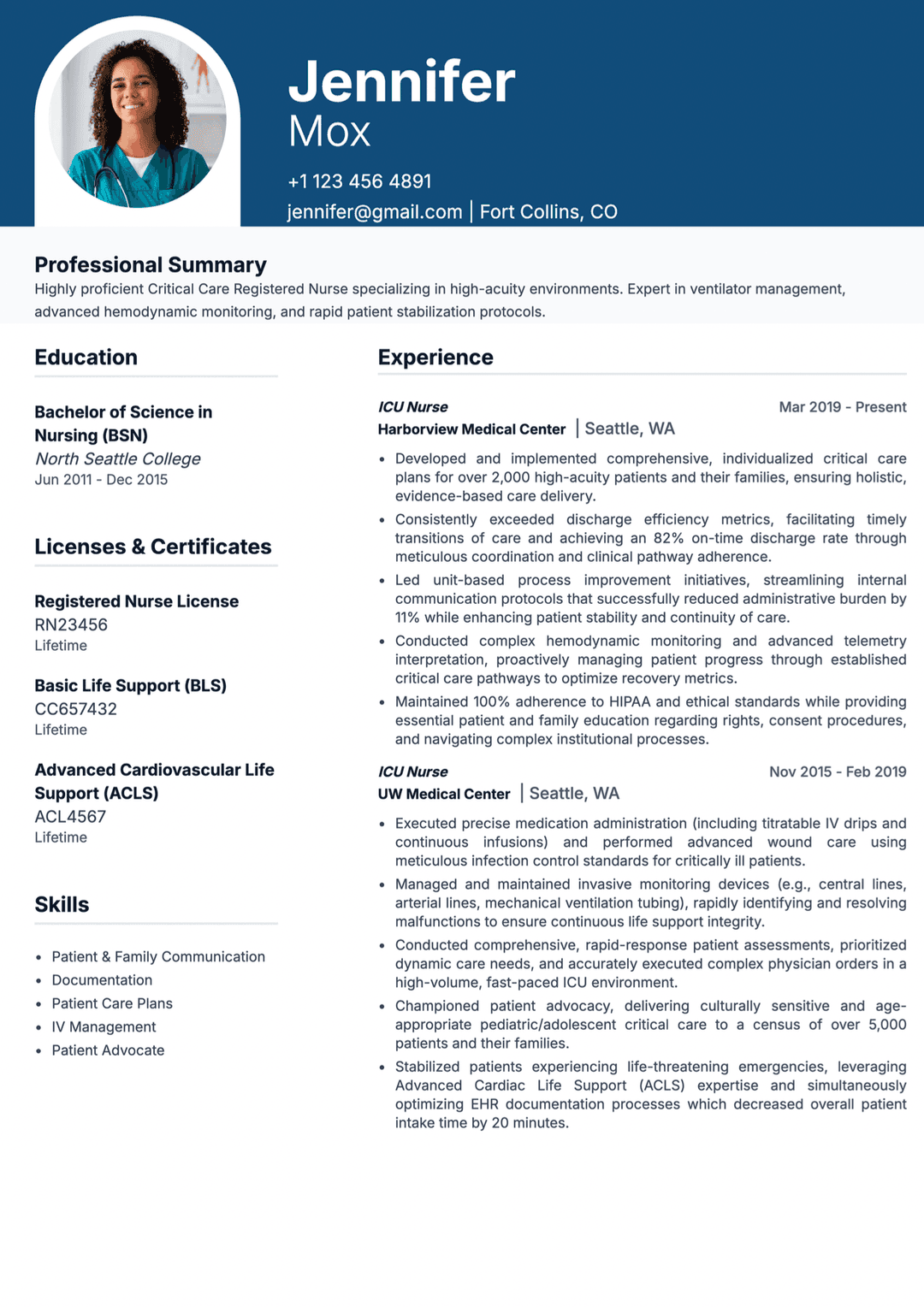
And finally, for nurses walking the specialty route, the Specialized RN Resume Example (ICU, ER, L&D, Med-Surg, Telemetry — your pick) has become essential. Specialty roles need more than general nursing statements. They require targeted metrics, relevant certifications (CCRN, TNCC, NRP, etc.), unit-specific skills, and bullets that match the high-stakes environment of these departments. Our ICU example, for instance, showcases titration of vasoactive drips, ventilator management, critical thinking under pressure, and collaboration with multidisciplinary teams. ER examples emphasize rapid triage, crisis intervention, trauma readiness, and familiarity with ED protocols. Each specialty resume links out to deeper specialty guides so nurses can tailor content even more precisely.
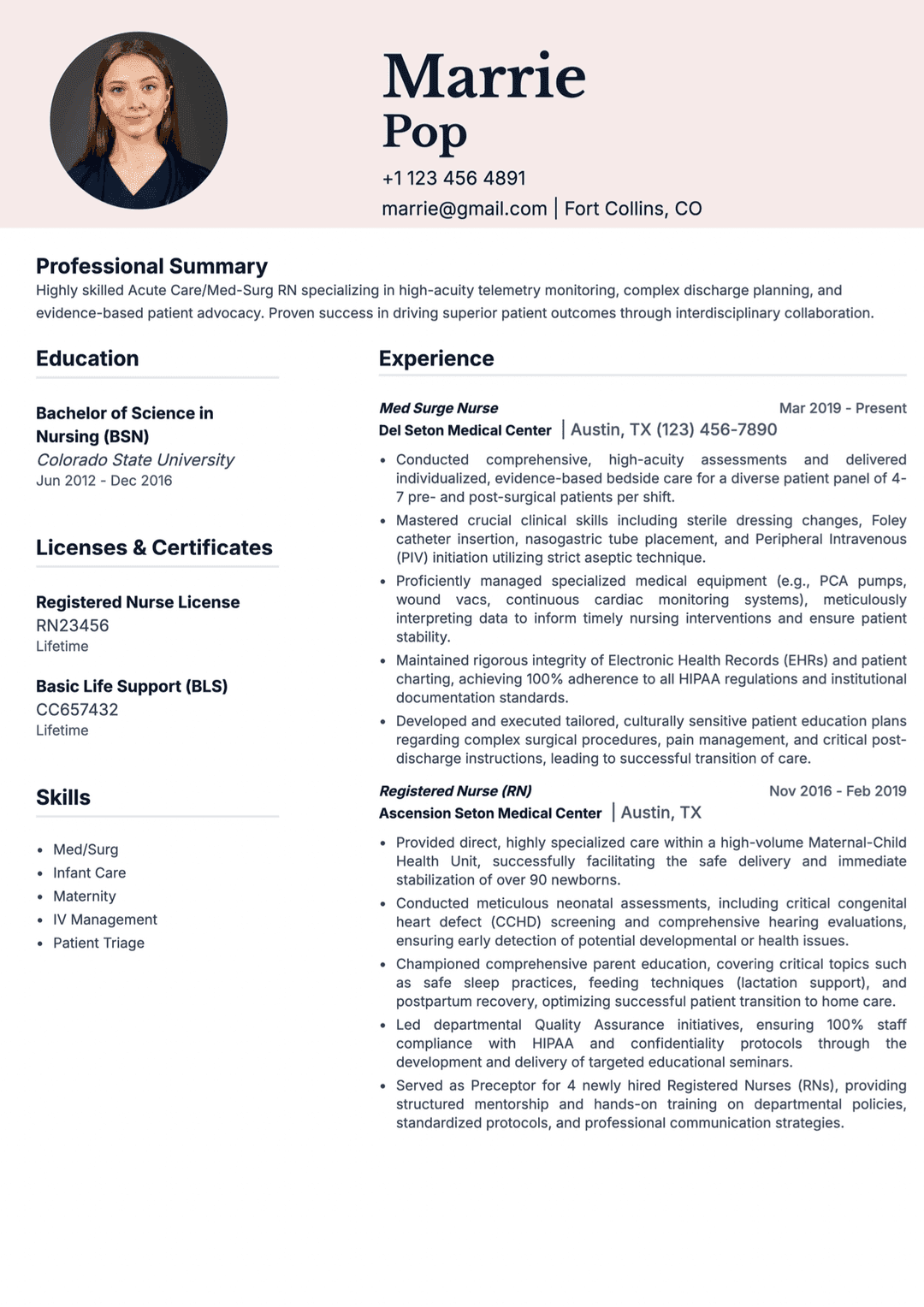
The primary lesson across all examples is this: clean formatting, quantifiable achievements, and content easily digestible by both humans and ATS bots.. That's exactly why thousands of nurses use NurseResumeBuilder.app — every template is built to meet real-world hiring standards without nurses needing to guess what recruiters want.
Use our professional template with proper formating.
Get AI-crafted summary and bullet points with professional resume templates.
RN Resume Format (The Best Resume Format for Registered Nurses)
If you've ever tried to read a coworker's shift handoff written in a panic at 06:58, you already understand why resume format matters. Hiring managers are basically doing the same thing—speed-reading through piles of applications while their coffee is still too hot to drink. That's why choosing the right RN resume format is less about aesthetics and more about survival. In 2025, hospitals are drowning in applicants, ATS scanners are pickier than a charge nurse during audits, and you need a format that does one job exceptionally well: present your clinical value clearly, cleanly, and in a way both humans and robots can digest.
Let's start with the format that should be tattooed on every nursing student's forearm: the reverse-chronological RN resume format. This is the gold standard, the "Tylenol and fluids" of resume writing—simple, reliable, and it works 99% of the time. Let me tell you why? Because hiring managers want to see where you've been and what you've done immediately and your most recent experience carries the most weight, especially in nursing, where new protocols, technologies, and care models pop up faster than we can keep track of. Whether you're applying for a Med-Surg position or the ICU, your most recent job shows the hospital how current your clinical skills and competencies are, additionally, this format plays beautifully with ATS systems, which scan resumes top-to-bottom looking for keywords like "RN licensure," "patient assessment," "medication administration," and "care coordination." Here is a secret, give the bots what they want, and they'll give your resume a green light.
Now... regarding the skills-based resume format, otherwise known as the "focus on abilities" option. Functional resumes prioritize competencies over chronology, arranging key proficiencies into clear, segmented categories such as "Technical Expertise," "Project Management," or "Interpersonal Strengths." Unfortunately, it's also a giant red flag for most hospitals. ATS systems have a harder time parsing them, and hiring managers may wonder whether you're hiding gaps, job hopping, or a lack of direct clinical experience; until you're making a major career pivot (like returning to bedside nursing after a long break), the functional format won't do you many favors. In the nursing world, "Show me where you've worked" will always beat "Trust me, I'm skilled."
There's also the combination resume format, which is basically a hybrid of the two. This format highlights skills at the top while still listing work history chronologically. If you're a seasoned RN with 10+ years under your belt, switching specialties, or showing off advanced competencies—think precepting, charge nurse responsibilities, or specialized certifications—this can work. But be warned: combination resumes tend to get long, and in the age of AI scanning and overworked recruiters, anything over one page makes them sigh deeply enough to trigger a Rapid Response.
Whichever format you choose, remember this: resume structure affects readability, and readability affects employability. ATS systems love clear headers, clean spacing, and standard section titles like "Experience," "Education," "Certifications," and "Skills." Your resume should read like a shift report: concise, factual, and easy to scan. And if formatting feels like trying to decipher a resident's handwriting during rounds, do yourself a favor—use NurseResumeBuilder.app. It automatically formats your RN resume in clean, ATS-friendly layouts built specifically for healthcare roles.
Because at the end of the day, your clinical expertise deserves more than a cluttered document standing between you and your next RN role. Let the format do the heavy lifting—so you don't have to.
How to Write a Registered Nurse Resume (Step-by-Step)
Look, I've been a nurse long enough to recall when charting meant paper records, 12-hour shifts quickly stretched into 15, and "self-care" was a stolen bite of a granola bar at 3 AM. So believe me when I assert this: crafting a Registered Nurse resume is far simpler than managing a shift where three call lights, one admission, and a newly disoriented patient simultaneously need attention.
The problem? Most RNs—whether new grads or seasoned warriors—treat resumes like afterthoughts. They throw in job duties, list every skill since the invention of stethoscopes, and pray the hiring manager is in a good mood.
But here's the truth no one tells you:
A strong RN resume isn't a list. It's a story. A clinical story told with data, clarity, and confidence.
And with tools like NurseResumeBuilder.app, you can craft that story without needing a triple shot of espresso or a minor meltdown.
Let's break this down step-by-step so you can write a resume that says:
"I know what I'm doing—and yes, you absolutely want me on your unit."
Start With a Strong RN Resume Summary (or Objective for New Grads)
Your resume summary is basically your elevator pitch—think of it like giving report, but to someone who doesn't know you yet. It should be short, confident, and packed with relevant information.
Summary vs. Objective: Which One Do You Use?
- Use a Summary if you have 1+ years of RN experience. This is where you highlight accomplishments, specialties, and strengths.
- Use an Objective if you're a new grad RN, transitioning career, or you have minimal clinical experience. This focuses on your goals, clinical rotations, and readiness to learn.
Examples
✔ Experienced RN Summary:
"Registered Nurse with 5+ years of acute care and med-surg experience, skilled in managing high-volume patient caseloads, reducing medication errors, and improving patient satisfaction metrics. Proven ability to work in fast-paced environments with strong clinical judgment and compassionate bedside care."
✔ Specialty RN Summary (ICU):
"Critical Care RN with 3 years of experience managing ventilators, titrating drips, and supporting high-acuity patients in Level I trauma ICU settings. Adept at rapid stabilization, interdisciplinary communication, and evidence-based interventions."
✔ New Grad RN Objective:
"Compassionate BSN graduate with 750+ hours of clinical rotations in ICU, Med-Surg, and Emergency care. Seeking an RN role where I can apply strong assessment skills, patient advocacy, and a passion for evidence-based practice while continuing to develop as a professional nurse."
If you want, NurseResumeBuilder.app will auto-generate summaries tailored to your specialty—so no staring at a blinking cursor wondering why you ever chose nursing in the first place.
2. Add Your RN Licensure, Certifications & Credentials
If you take nothing else from this guide, take this:
The #1 thing recruiters and ATS systems search for is your RN license.
No license → No interview → Do not pass Go.
How to List RN Licensure Properly
The standard format is:
- Registered Nurse (RN) — State
- License Number: #######
- Expiration: MM/YYYY
- Status: Active
If you're licensed in multiple states via the compact system, add "Compact License Holder."
Certifications That Matter (List Them Separately)
Recruiters love seeing these front and center:
- BLS – Basic Life Support
- ACLS – Advanced Cardiovascular Life Support
- PALS – Pediatric Advanced Life Support
- TNCC – Trauma Nursing Core Course
- NIHSS – Stroke Certification
For specialties, add:
- ICU: CCRN
- ER: CEN
- OR: CNOR
- L&D: RNC-OB
Certs show competence. They also show you're the type of nurse who does their CEUs before the deadline—which immediately puts you ahead of half the applicant pool.
3. Write a Strong RN Experience Section
Keywords: experienced rn resume, resume for rn bsn, good nursing resume examples
Your experience section is where you shine. And no, "Provided compassionate patient care" is not shining. Every nurse on Earth does that.
Hiring managers want impact, not tasks.
How to Write Better RN Resume Bullets
Use the simple formula I swear by:
Action Verb + Clinical Task + Measurable Outcome
Examples:
- "Managed 5:1 patient ratios in a high-acuity med-surg unit while maintaining a 98% documentation accuracy rate."
- "Reduced medication errors by 17% through implementation of double-check systems and improved MAR workflows."
- "Provided pre- and post-op care for 30+ orthopedic surgical patients weekly, improving patient satisfaction scores by 12%."
- "Led rapid response activations, ensuring timely intervention and improved patient stabilization outcomes."
Numbers are your friend—use them the same way we use coffee: strategically and frequently.
If You're a New Grad
Don't panic. You still have experience—just not paid experience.
Use clinical rotations and highlight responsibilities like:
- Administered medications
- Performed assessments
- Collaborated with interdisciplinary teams
- Documented patient progress
- Assisted in wound care, IV starts, Foley insertion
4. Highlight Clinical Skills for Registered Nurses
Skills are like your nursing toolbox—what you bring to the unit on Day 1.
Hard Clinical Skills
These should be specific and relevant:
- Patient assessment
- IV therapy & line management
- Medication administration
- Wound care
- Telemetry monitoring
- Catheterization
- Tracheostomy care
- Tube feeding
- Post-op care
- Pain management
- Vitals & monitoring
Soft Skills (a.k.a. Survival Skills)
- Communication
- Critical thinking
- Empathy
- Time management
- Crisis management
- Patient education
- Attention to detail
Soft skills matter just as much as knowing how to spike a bag correctly.
Pro Tip
Don't list every skill known to mankind. Tailor skills to the job description. ATS bots eat that up.
5. Include RN Clinical Experience (For New Grads)
For a new graduate RN, your clinical rotations serve as your experience section. However, inadequately presenting them can make you appear inexperienced—regardless of your actual competency.
How to Format Clinical Rotations
List them like real jobs:
- Hospital Name — Unit
- Hours Completed: ###
- Key Responsibilities:
- Performed head-to-toe assessments
- Administered PO/IV medications
- Assisted with wound care
- Documented in EMR systems (Epic, Cerner, etc.)
- Educated patients on post-discharge care
Include:
- Preceptorships
- Capstone projects
- Senior practicum
- Leadership or delegation experience
If you precepted in ICU, ER, or OR—highlight it. Recruiters love that.
Pro tip from me:
rotations are not "filler content." They show clinical readiness. Sell them well.
6. Add Education for RN Students & Graduates
Keywords: graduate nurse resume, new grad nurse resume example, example of a nursing student resume
Education is straightforward—mostly.
How to List It Properly
- Bachelor of Science in Nursing (BSN)
- University Name — Graduation Year
- Honors: Cum Laude (if applicable)
- GPA: Only if above 3.5 (and if you're a new grad)
BSN vs ADN
Should you mention differences?
If you have a BSN, yes—highlight it. If you have an ADN, that's fine too. Many strong RNs came through ADN programs, but highlight clinical excellence to bolster your profile.
New Grads Should Add:
- Relevant coursework (Pathophysiology, Pharmacology, etc.)
- Capstone project title
- Simulation lab experience
- Student nurse leadership roles
7. Add RN Technical Skills & EHR Systems
If you've ever spent an entire shift fighting with Epic after a new update, congratulations—you have technical skills. But on your resume, you need to list them clearly.
EHR Systems to Include
- Epic
- Cerner
- Meditech
- Allscripts
- eClinicalWorks
EHR systems are huge ATS keywords—don't skip them.
Additional Technical or Equipment Skills
- Infusion pumps
- Ventilators
- Telemetry monitors
- Glucometers
- Portable oxygen devices
- Automated medication dispensing systems (Pyxis/Omnicell)
The more relevant your technical skills, the faster a hiring manager can place you into a specialty or unit.
Use our AI to write your specialised skills.
Get AI-crafted summary and bullet points with professional resume templates.
Top Registered Nurse Resume Skills for 2025
When it comes to writing a Registered Nurse resume in 2025, your skills section is no longer just a polite little list tucked between "Experience" and "Education." It's a full-blown highlight reel for the role.. Recruiters skim it before they read anything else. ATS bots scan it to decide whether you deserve to move to round two. And hiring managers—many of whom are former nurses themselves—use it to quickly judge whether you can survive a chaotic 12-hour shift without crying in the supply closet. So yes, your RN resume skills list needs to be strong, specific, and tailored to the unit you're applying for. This is not the time for vague fluff like "team player" or "hard worker." Every nurse is a hard worker—you're in healthcare, not a hammock shop.
Start by building a General RN Skills foundation. These are the universal "you must have these or you're not getting through HR" abilities: patient assessment, administering medications accurately (but of course), monitoring vital signs, care planning, documentation, infection control, wound care, and collaborating with multidisciplinary teams. Think of these as your bread and butter—reliable, expected, and essential. However, don't just list them; make sure they reflect real clinical competence. If you've mastered electronic health records like Epic, Cerner, Meditech, or Allscripts, call that out too. In 2025, knowing your way around an EHR saves time, prevents errors, and frankly, saves your sanity.
Next, tailor your skills to specialty-specific areas, because recruiters want to see evidence of real-world applicability. For example, if you're applying to a Med-Surg unit, highlight patient education, discharge planning, post-op care, multi-patient prioritization, and proficiency with things like telemetry monitoring or wound vacs. If you're applying to an OR position, emphasize skills like sterile field maintenance, assisting in surgical procedures, instrument management, and perioperative assessments. Specialty sections help your resume stand out and prove you're not just "nurse-capable" but "unit-ready."
For those who live in the land of alarms and adrenaline, let's talk Critical Care Skills. ICU is its own breed of nursing, and your resume should reflect that. Think ventilator management, titrating vasoactive drips, interpreting arterial blood gases, responding to rapid deterioration, and using advanced monitoring tools like Swan-Ganz catheters or ICP monitors. Instead of simply writing "critical thinking," show them you've literally kept patients alive by catching a drop in MAP before anyone else noticed. If your experience leans this way, point the reader to resources like your ICU Nurse Resume guide (internal link).
Speaking of adrenaline, those aiming for emergency settings need to showcase Emergency Room (ER) Skills. ER recruiters want fast thinkers, not slow blenders. Your skills should include triage expertise, trauma care, rapid assessments, stabilizing critical patients, running codes, wound closure assistance, and handling high-stress situations without turning into a human stress ball. Show your ability to move from a sprained ankle to a STEMI to a full-blown trauma without losing your cool. And if ER is your specialty, your resume will benefit from checking out our nurse resume templates for specialty-specific guidance.
Then, there's the beautiful world of Telemetry Skills, which sits somewhere between "critical care lite" and "we're definitely watching you closely." Include skills like rhythm interpretation (don't just say "telemetry"—say "interprets 12-lead ECGs and identifies lethal arrhythmias"), chest pain protocols, cardiac monitoring, and managing drips commonly used in tele units. If you've handled post-MI patients, pacemakers, or had a role in rapid response activations, mention it. These details differentiate you from someone who's seen telemetry vs someone who "gets" it.
The key to success in the talent market is being specific, relevant, and honest. Anyone can list "critical care" or "emergency nursing," but showing the nuanced, hands-on competencies that only experience teaches? That's what makes a recruiter think, "Oh, this nurse knows what they're doing." And don't forget to check out deeper specialty guides like ICU Nurse Resume and explore our complete nurse resume guide for ER, Med-Surg, and other specialty templates—it boosts SEO, and also gives your readers tailored advice they can act on immediately.
Your skills aren't just a section—they're your clinical identity. Make them count.
Registered Nurse Job Description for Resume (Copy & Paste Examples)
If you've ever stared at your cursor blinking on a blank Word document thinking, "How do I turn a decade of bedside chaos, 47,000 medication passes, and 900 shift handovers into resume bullets?" — welcome to the club. Writing your job description as a Registered Nurse can feel harder than managing a four-patient assignment with two fresh post-ops and a confused gentleman trying to climb out of bed for the third time. But here's the truth: your RN job description isn't just a list of tasks. It's your chance to prove you're the calm in the storm, the backbone of patient care, and the nurse every hiring manager wants on their unit.
A strong RN job description on your resume does three things:
- Shows your clinical expertise
- Proves your impact with measurable results
- Highlights your specialty skills (because, yes, ICU nurses and tele nurses live in different universes)
Below are plug-and-play RN job description examples tailored for the most common nursing specialties. Elevate your resume's impact with these compelling statements, or utilize a specialized tool like NurseResumeBuilder.app for instant, customized bullet point generation.
General Registered Nurse Job Description (All Units)
This version is perfect for a standard RN role in clinics, acute care, rehabilitation centers, or medical offices.
- Delivered compassionate, evidence-based care to diverse patient populations while managing assessments, medication administration, and interdisciplinary communication.
- Performed ongoing evaluation and documentation of patient conditions, collaborating with physicians and support staff to coordinate individualized care plans.
- Educated patients and families on treatment plans, medications, and discharge instructions to promote safety and prevent readmissions.
- Ensured compliance with hospital policies, infection control standards, and patient safety protocols to maintain Joint Commission accreditation.
- Utilized EHR systems such as Epic, Cerner, or Meditech to ensure accurate and timely charting.
ICU Registered Nurse Job Description
If you've ever titrated vasopressors in a dark room at 2 a.m., you deserve a resume that reflects that heroism.
- Provided continuous monitoring and complex care for critically ill patients requiring advanced interventions such as mechanical ventilation, hemodynamic support, and continuous renal replacement therapy.
- Managed titration of vasoactive medications, sedation, and analgesia while ensuring patient stability and safety according to ICU protocols.
- Performed rapid assessments, interpreted cardiac rhythms, ABGs, and lab results, and initiated interventions in collaboration with intensivists.
- Responded to emergency situations including code blues, rapid response activations, and sepsis alerts, employing evidence-based critical care practices.
- Delivered end-of-life support and communication for families during high-stress, emotionally sensitive events.
Emergency Room RN Job Description
Because the ER is basically "organized chaos with fluorescent lighting."
- Conducted rapid triage assessments to identify high-priority patients and initiate time-sensitive interventions.
- Provided immediate care for trauma, cardiac, respiratory, neurological, and behavioral emergencies in a fast-paced, high-acuity environment
- Performed critical procedures including IV access, wound care, splinting, EKG interpretation, and medication administration under pressure.
- Collaborated with interdisciplinary teams to stabilize, treat, and transition patients to inpatient units or appropriate discharge destinations.
- Maintained proficiency in crisis de-escalation and patient safety strategies for emotionally volatile situations.
Med-Surg RN Job Description
The backbone of every hospital—where you do "a little bit of everything."
- Managed care for a diverse caseload of postoperative, chronic, and acute medical patients, typically balancing 4–6 patients per shift.
- Conducted head-to-toe assessments, monitored patient progress, and updated care plans based on changing conditions.
- Administered medications, managed IV pumps, performed wound care, and coordinated diagnostic tests with interdisciplinary staff.
- Prioritized patient needs using strong time management skills while maintaining safety, accuracy, and compassion.
- Educated patients on disease management, lifestyle modifications, and discharge instructions to support long-term recovery.
Telemetry RN Job Description
For the nurse who knows cardiac rhythms better than they know their own sleep schedule.
- Monitored cardiac rhythms, identified abnormalities, and communicated critical changes to providers promptly.
- Managed care for patients with arrhythmias, heart failure, post-cardiac procedures, and other cardiovascular conditions.
- Interpreted EKG strips, assessed hemodynamics, and collaborated with cardiology teams for timely interventions.
OR / Perioperative RN Job Description
Scrub life = real life.
- Provided pre-, intra-, and postoperative nursing care, ensuring patient safety and sterile technique adherence.
- Assisted in surgical procedures by preparing instruments, anticipating surgeon needs, and maintaining a sterile field.
- Coordinated patient handoffs and documented surgical details accurately in the EHR.
Pediatric RN Job Description
For nurses fluent in both medical terminology and baby shark.
- Delivered age-appropriate, family-centered care for infants, children, and adolescents in acute or chronic settings.
- Coordinated treatments, vaccinations, IV access, and education tailored to developmental stages.
Home Health RN Job Description (Copy & Paste)
AKA: You, a car, and 500 miles of weekly home visits.
- Performed skilled nursing assessments, wound care, medication management, and chronic disease monitoring in home settings.
- Educated families on safety, medication administration, and long-term health management.
If you'd like, I can also write: ✅ A bullet bank of 100+ RN resume bullets ✅ Specialty versions for NICU, L&D, Tele, Oncology, PACU, Psych, CCU, CVICU. Just tell me which specialty you want next.
Download Free RN Resume Templates (ATS-Optimized)
If you've ever tried squeezing your entire nursing career, all your certifications, every 12-hour shift that felt like a season finale of Grey's Anatomy, and your ability to stay calm while three IV pumps start beeping at once—onto one sheet of paper… you know it's not for the faint of heart. That's exactly why having the right Registered Nurse resume template matters. And no, I don't mean those glittery, two-column Canva resumes that look cute but confuse Applicant Tracking Systems faster than a new grad during their first code blue. I'm talking about clean, clinical, ATS-optimized RN resume templates built specifically for nurses—and yes, you can download them for free right here.
The templates at NurseResumeBuilder.app are specifically crafted for the realities of nursing hiring. Healthcare recruiters seek clarity, not fluff. They want to see your licensure, your clinical competencies, your specialty experience, and your quantifiable impact—without having to dig through decorative icons and pastel borders. That's why every template we offer is structured in the exact order healthcare employers expect: RN Summary → Licensure & Certifications → Clinical Experience → Skills → Education. No guesswork. No getting lost. No getting rejected because the ATS couldn't read your resume.
We offer a full lineup of professionally designed templates to match where you are in your nursing journey. The Modern RN Template gives you a polished, leadership-ready aesthetic—perfect if you're applying to magnet hospitals or stepping into roles like Charge Nurse or Nurse Manager. The Clinical RN Template is straightforward and hospital-approved, highlighting your hard skills (think: wound care, telemetry monitoring, IV pushes, ventilator management). It's ideal for bedside roles, critical care positions, and high-acuity environments where your competencies matter more than your font choices.
Then there's the Minimalist RN Template, my personal favorite. It's crisp, quiet, and commandingly professional—kind of like that one nurse on the unit who never panics, even when everyone else is losing their minds. It uses tight spacing, smart section headers, and uncomplicated formatting so your skills jump off the page without overwhelming it. And of course, we didn't forget the newcomers: the Nursing Student / New Grad RN Template, crafted to showcase clinical rotations, preceptorships, technical skills, and transferable strengths when your paid experience is still catching up.
Every template includes nurse-specific keyword placement, like "patient assessment," "medication administration," "care coordination," "acute care," "EHR documentation," and dozens of high-value terms ATS systems are trained to look for. You won't have to wonder if your resume will pass the digital gatekeeper—it will. And because each layout is built to be edited seamlessly inside NurseResumeBuilder, you don't need design skills, formatting experience, or a stack of sticky notes to rearrange sections. Just plug in your details and the tool aligns everything perfectly.
Whether you're an ICU warrior, a Med-Surg multitasker, a fresh-faced new grad, or a seasoned RN with enough stories to fill a memoir, you deserve a resume that reflects your skill—and gets you hired. Download your templates for free and build your RN resume the smart, stress-free way.
RN Resume Samples by Specialty (Internal Silo Section)
After a significant time in nursing, you realize that units and résumés each possess unique attributes. An ICU nurse's day looks nothing like a sunny pediatric shift, and a Med-Surg RN's report sheet is practically a novella compared to an ER nurse's cryptic shorthand. That's exactly why the best Registered Nurse resumes are specialty-specific. Recruiters aren't just scanning for "RN, ACLS, BLS." They're looking for the nuanced, unit-level competencies that prove you've actually lived through the chaos, survived the charting, and mastered the skills that matter in their environment. This is where curated RN resume samples by specialty come in—they help you highlight the exact clinical strengths that get you hired fast.
If you're headed toward the ICU, your résumé needs to scream precision, vigilance, and "I can titrate fifteen drips while predicting the future." Our ICU nurse resume, ICU RN resume, and ICU resume examples focus on ventilator management, hemodynamic monitoring, vasoactive titration, and those tiny wins that only critical care nurses understand. Meanwhile, if you're an Emergency Nurse, your résumé needs to show speed without sloppiness—triage expertise, trauma skills, rapid assessments, and that uncanny ability to stay calm while everyone else is losing their minds. Our emergency nurse resume and emergency department RN resume samples help you highlight exactly that.
For Med-Surg nurses, it's all about showcasing versatility. You're the Swiss Army Knife of nursing—post-op care, wound management, patient education, and juggling an entire census like it's a casual Tuesday. The Med-Surg nurse resume samples emphasize high patient ratios, multidisciplinary coordination, and complex care planning. Shift to Labor & Delivery, and your résumé needs to reflect confidence in fetal monitoring, emergency interventions, and guiding families through the wildest day of their lives. L&D hiring managers want to see poise, compassion, and clinical strength—and our labor and delivery nurse resume examples deliver.
If your heart is in pediatrics, the résumé tone shifts to emphasize family-centered care, expertise in growth and development, and the patience of a saint. Our pediatric nurse resume templates reflect the gentle but skilled touch recruiters expect. Telemetry nurses, on the other hand, need to showcase rhythm interpretation, cardiac monitoring, and quick intervention skills. And if you're in Psychiatric or Mental Health nursing, you'll want your résumé to highlight de-escalation, crisis intervention, trauma-informed communication, and therapeutic rapport—traits that shine in our psychiatric nurse resume samples.
For oncology warriors—yes, you with the port access mastery and the emotional resilience of a boulder—our oncology RN resume templates prioritize chemo certification, symptom management, and patient advocacy. Home Health nurses need to highlight autonomy, patient education, wound care, and community-based decision making. And Travel Nurses? Your résumé must prove adaptability across facilities, charting systems, and staffing ratios—it's practically a badge of honor, and our travel nurse resume examples showcase exactly that.
We also include specialty résumé variations for LPNs, CNAs, NNPs, and other allied nursing roles—because every nurse deserves a résumé that fits like perfectly broken-in nursing clogs.
By linking to specialty pages, you boost SEO and establish deep authority, which gives nurses confidence to apply using résumés built specifically for their niche.
New Grad RN Resume Guide (For Nurses With No Experience)
Listen, if you're a brand-new RN staring at a blank resume and wondering how on earth you're supposed to impress a hiring manager without a single shift of paid nursing experience… take a breath. Every single nurse you admire—yes, even the ones who strut around the unit like they invented the stethoscope—started exactly where you are: fresh scrubs, shiny license, zero professional experience, and a resume that felt thinner than hospital coffee. The good news? New graduate RN resumes are actually easier to write than experienced ones—as long as you know what hospitals are looking for. Spoiler: it's not years of bedside time. It's clinical competence, teachability, and the ability to hit the floor running.
So, here's how to write a powerful new grad RN resume with no experience that still makes you look like someone worth betting on.
First, lean hard into your clinical rotations. This is very important for a new nurse resume. Those 120 hours you did in Med-Surg weren't "just student hours"—they were actual patient care. Hiring managers know this. List each rotation like a mini job: include the hospital name, unit, number of hours, and 3–5 bullet points describing what you did. Highlight hands-on skills: performing assessments, administering medications under supervision, documenting in EHRs, collaborating with preceptors, practicing safe patient handoffs. Don't just say "assisted nurses." Give details. If you helped manage a 5-patient assignment, say it. If your preceptor trusted you with complex wound care or telemetry interpretation, write it. These details show readiness—and confidence.
Then, don't underestimate the power of preceptorships and capstone projects. If you had a 1:1 senior practicum or spent your final semester embedded in a unit like ICU, ED, or L&D, that's gold. Many managers weigh preceptorships just as heavily as paid RN experience, because it proves you've already worked at near-independent capacity. Describe clinical accomplishments: "Completed 180-hour senior practicum in a Level I Trauma ED, autonomously performing assessments, initiating EKGs, and supporting triage under RN supervision." Yes, that absolutely counts.
Next up: volunteer work and healthcare-adjacent experience. Maybe you worked as a CNA, volunteered at a vaccination drive, or spent weekends taking vitals at a community clinic. These experiences speak volumes about your dedication to patient care. Even roles like caregiver, EMT trainee, or unit secretary add value—anything that shows familiarity with healthcare environments, patient interaction, or multitasking under pressure.
Here are sample bullet points you can use (and tweak to your experience):
- Conducted full head-to-toe assessments and documented findings in Epic under RN supervision.
- Managed 3–5 patient assignment during final practicum, prioritizing care and coordinating with interdisciplinary teams.
- Assisted with wound care, IV starts, blood glucose monitoring, and medication administration (per state guidelines).
- Supported patient education on discharge planning, chronic disease management, and medication safety.
Upholding perfect accuracy in documentation and strict adherence to safety guidelines. I'm looking for a team where I can rapidly grow, humbly own my mistakes, and contribute with a focused, learning mindset.. Use your summary to express enthusiasm and purpose, not overconfidence. Something like: "Compassionate new graduate RN committed to evidence-based care and eager to grow within a supportive team environment."
And remember: you don't need to stress about formatting or keyword optimization. You can build a polished, ATS-ready new grad RN resume instantly using NurseResumeBuilder.app, which automatically inserts clinical rotations, skill keywords, and professional bullet points tailored for new nurses.
For even deeper guidance, check out the full New Graduate Nurse Resume Guide on our site.
What Recruiters Look for in a Registered Nurse Resume
If you've ever wondered what's going through a nurse recruiter's mind when they're sifting through a mountain of RN resumes at 7:45 AM with lukewarm coffee, here's the unfiltered truth from someone who's seen both sides of the medication cart. Recruiters aren't just looking for a list of duties—they're looking for confidence, clarity, clinical competence, and numbers that prove you didn't just show up for your shift… you made an impact. And in 2025, with ATS filters acting like digital bouncers, you need more than a pretty template to make it past the velvet rope.
Let's start with the most critical factor: ATS keyword optimization. Whether you love them, hate them, or wish they would spontaneously combust, Applicant Tracking Systems are gatekeepers now. If your resume doesn't include keywords like patient assessment, wound care, medication administration, IV therapy, telemetry, EHR documentation, or specialty-specific terms like ventilator management or rapid triage, you may never reach a real human. Recruiters expect your resume to speak their language—and the ATS's language—simultaneously. That's exactly why thousands of nurses use NurseResumeBuilder.app: it automatically loads your resume with the correct keywords based on your specialty, eliminating the guesswork.
Once you clear the ATS hurdle, recruiters look for the one thing most nurses forget to include: outcomes. Not tasks. Outcomes. Because every RN knows charting "provided patient care" means absolutely nothing. Recruiters want proof that you made measurable, meaningful contributions. Instead of "monitored vital signs," give them this: "Monitored and analyzed vitals for 5–6 high-acuity patients daily, identifying early deterioration and reducing code blue events by 12%." Instead of "administered medications," say, "Achieved 98% medication administration accuracy for a 34-bed unit over 18 months." Numbers show competence. Numbers show responsibility. Numbers show impact. And most importantly—numbers help you stand out in a pile of identical bullet lists.
Now let's talk about red flags—the things recruiters notice faster than you can say "PRN shift." The first is job hopping without context. Nursing is tough. Burnout is real. Travel nursing is booming. Recruiters get it. But if you've switched facilities every six months without explanation, you need to address it professionally. A simple note in your summary—"Pursued contract-based roles to broaden clinical experience"—can turn a red flag into a green light.
The next red flag is poor formatting. Think of your resume like a sterile field: keep it clean, organized, and easy to navigate. Walls of text, inconsistent spacing, missing dates, creative fonts, and chaotic layouts all tell recruiters, "This nurse may not be the most detail-oriented." And trust me, no one wants a sloppy resume from someone who handles IV lines and narc counts. This is why nurses love the templates at NurseResumeBuilder.app—they're built to look good, load fast, and glide through ATS scanners.
Finally, avoid vague responsibilities. "Provided patient care," "worked in a team," and "strong communication skills" might as well be printed on a mug in the hospital gift shop—they're that generic. Recruiters want specifics: patient load, unit type, equipment used, critical interventions, and measurable improvements.
At the end of the day, recruiters want a resume that reads like a record of clinical excellence—not a shift report. And with the right keywords, clean formatting, and outcome-driven bullet points, your RN resume won't just get seen… it'll get remembered.
Common RN Resume Mistakes to Avoid
Look, after 15 years in scrubs, three different badge lanyards, and more night shifts than I care to count, I can tell you this: nurses don't usually mess up patient care—but we are surprisingly good at messing up our resumes. And the worst part? These mistakes are avoidable, yet they cost great nurses interviews every single day. As someone who has sat on hiring panels, precepted more new grads than I can remember, and helped hundreds polish their resumes through NurseResumeBuilder, let me break down the biggest RN resume mistakes that quietly sabotage your application and how to fix them—stat.
1. Turning Your Resume Into a Menial Task Laundry List
If your experience section reads like: "Gave meds. Assisted patients. Changed dressings. Helped with ADLs," then we need to talk. That's not a resume—that's a job description taped to the med cart. Every RN in America does these basic tasks; they don't set you apart. Recruiters don't want a log of tasks—they want to see impact. What did you actually achieve? Did you reduce falls by educating confused patients? Did you manage a 6:1 ratio during a staffing crisis without compromising safety? Did you facilitate smoother discharges by collaborating with case management? Numbers and outcomes speak louder than tasks. Use action verbs and quantifiable results. Think of it this way: "Gave meds" tells me nothing; "Administered medications to 20+ patients daily with zero med errors for 14 consecutive months" tells me everything.
2. Forgetting Your Numbers (A Cardinal Resume Sin)
Nurses love data when we're charting or giving report, but when it comes to resumes, suddenly we forget numbers exist. Meanwhile, recruiters crave quantifiable details—they prove competence. Don't just say, "Experienced in high-acuity care." Show it. How high acuity? Stepdown? ICU? Trauma? How many patients per shift? What kind of outcomes did you influence? Did you improve a workflow? Did you precept 12 new nurses in one year? Numbers add legitimacy to your experience. They also help the ATS score your resume against the job description. No numbers = no context = no interview.
3. Using Incorrect or Vague Nursing Terminology
This is a silent killer. Using generic or outdated terms ("ward nurse" or "assist doctors") instantly signals you're not in tune with modern practice. Also, many nurses underestimate the importance of aligning terminology with ATS systems. For example, telemetry monitoring isn't the same as cardiac monitoring in some hospitals' keyword structures. Likewise, "code situations" might not register, but "rapid response activation" will. And please—remember your specialty language matters. ICU resumes should talk about titration, vasopressors, ventilator management. ER resumes should include triage, trauma, stabilization. If you're not using the right clinical language, the ATS not only misreads your experience—human recruiters question your expertise.
4. Listing Expired or Irrelevant Certifications
You'd be shocked how often this happens. If your BLS expired two years ago or you still have "COVID tracing volunteer" as your top credential, it's time for a resume detox. Recruiters take recency seriously. Expired certifications, outdated training, or old clinical rotations do nothing but clutter your resume and raise eyebrows. Keep credentials clean, current, and relevant. Your resume should read like a confident snapshot of who you are today, not a scrapbook of what you did five years ago.
If all this feels overwhelming, you're not alone. Most nurses weren't taught resume writing in school—but that's exactly why tools like NurseResumeBuilder.app exist. It automatically formats your resume, injects clinical terminology, and removes these common mistakes before they ever reach a recruiter's desk. Consider it your resume preceptor—minus the side-eye and passive-aggressive Post-its.
Use our AI to write your spealised resume.
Get AI-crafted cover letter with professional template.
RN Cover Letter (Template + Sample)
If the resume is the heart of your application, then the cover letter is the blood pressure cuff that tells the hiring manager exactly how strong your pulse is. And trust me—after 15 years of bedside chaos, night shifts, patient families, mystery smells, and budget cuts that magically get blamed on "supply chain issues," I've learned one thing: nurses who write great cover letters get interviews faster. Your RN cover letter isn't meant to regurgitate your resume or list every certification you earned since your NCLEX meltdown. Instead, it's your chance to sound human, confident, competent, and genuinely excited about the job. A good cover letter tells a story. A great one tells the right story—and does it quickly, clearly, and with a touch of nursing professionalism. Think of it as SBAR, but make it HR-friendly.
Start with a clean, professional header—name, credentials, phone, email, and LinkedIn if you haven't abandoned it like that one stethoscope you lent to a coworker and never saw again. Then address the hiring manager by name (yes, it matters—no more "To Whom It May Concern," unless you want your application to mysteriously vanish into the mythical HR black hole). In your opening paragraph, state the role you're applying for and hook them with a quick intro that shows personality and purpose. Something like: "With five years of experience in high-acuity med-surg settings and a passion for patient advocacy, I'm excited to apply for the Registered Nurse position at Mercy General Hospital." Not Shakespeare, but strong, clean, confident—and that's exactly the goal.
Next, dive into a brief story that highlights your strongest accomplishments. Emphasis on brief. You're not writing a memoir. Pick the wins that matter: improving patient satisfaction scores, reducing med errors, precepting new nurses without crying in the break room, leading rapid responses, managing heavy ratios without compromising care, or building strong relationships across interdisciplinary teams. Use numbers wherever you can. HR people love numbers like nurses love a fully stocked supply room. For example: "In my previous role, I consistently managed a 5:1 patient ratio while maintaining a 98% medication safety record and helping improve unit HCAHPS scores by 12% over two years." Numbers = impact. Impact = interview.
Your third paragraph should make it clear why this hospital or unit matters to you. Yes, you. You're allowed to care about where you work. Mention their values, patient population, specialties, or community involvement. Hiring managers appreciate when you show you did your homework. Something along the lines of: "I'm particularly drawn to Mercy General's commitment to evidence-based practice and its well-known mentorship program for advancing RN clinical skills." Translation: "I know who you are, and I want to be part of it." Gold star.
Finally, wrap up with a confident thank-you and a subtle reminder that you're, well, awesome—but professionally awesome. Something like: "Thank you for considering my application. I would welcome the opportunity to bring my clinical expertise, patient-centered care approach, and strong teamwork skills to your nursing team." Add a nice sign-off and your credentials, and boom—cover letter done.
If all of this feels overwhelming, don't panic. That's why NurseResumeBuilder.app exists—to help you write a nursing resume and cover letter without the headache. The tool even generates customizable, hiring-manager-approved RN cover letters based on your specialty, experience level, and achievements. So if writing isn't your thing (no judgment), let the tool handle the heavy lifting while you handle… well, everything else nurses handle.
Build Your Registered Nurse Resume in Minutes (ATS-Friendly)
After two decades in scrubs, badge reels, and caffeinated survival, I can tell you one thing with absolute certainty: your Registered Nurse resume should not feel harder than managing four fresh post-ops, a confused fall-risk, and a pump that won’t stop beeping. Yet here we are—nurses everywhere juggling night shifts, charting marathons, and job applications that feel like an NCLEX question written by someone who enjoys your suffering. That's exactly why a tool built specifically for nurses is no longer a luxury; it’s practically a workplace safety measure. And that’s where NurseResumeBuilder.app steps in like that one charge nurse who actually knows what they’re doing and magically makes your whole shift better.
The truth is, nursing resumes aren’t like corporate tech resumes where you can throw in words like “synergy” and “proactive collaboration,” hope for the best, and call it a day. Nope. Healthcare resumes operate in a different universe—one shaped by clinical terminology, high-stakes responsibilities, and ATS screening bots who definitely didn’t go to nursing school but still judge your resume. And that’s exactly why most generic resume tools miss the mark. They don’t understand nursing language, nursing workflows, or the microscopic performance indicators that make hiring managers think, “Okay, this nurse knows their stuff.”
NurseResumeBuilder is built differently—created for healthcare, tailored for clinical roles, and optimized for the competencies that real RNs use every single day. Instead of forcing you to figure out how to phrase “I kept patients alive with grace and limited resources,” the tool automatically inserts nursing-specific keywords—from medication administration and rapid response interventions to EHR documentation, wound care, telemetry monitoring, evidence-based practice, patient education, and all the other things that make you sound like the competent, seasoned professional you already are. Whether you’re an ICU adrenaline junkie, a Med-Surg Swiss-army knife, or an ER triage wizard who deserves hazard pay and a parade, the builder adapts to your specialty and selects the skills recruiters actually look for.
And because the hiring world now runs on ATS—the robotic gatekeepers scanning for keywords with the enthusiasm of a new grad nurse scanning the crash cart—the platform also ensures that every line of your resume is readable, clean, and properly structured. No weird formatting, no disappearing sections, no margins that shift like a confused float nurse. Just a clean, modern, professional RN resume created in minutes. At the end, you get a PDF that’s truly ATS-ready—not the “pretty but useless” kind you find on Pinterest.
Plus, let’s talk time. You’re busy. You may be reading this on a 12-hour shift, during the three minutes between vitals and meds, or while hiding in the supply room pretending to “look for gauze” so you can breathe. You don’t have hours to craft a resume from scratch. With NurseResumeBuilder, you plug in your details, choose your specialty, select your accomplishments, and boom—your RN resume is ready in under two minutes. Faster than pharmacy sends meds, more accurate than the float nurse who writes “WNL” on everything, and definitely easier than charting a simple PRN med in Epic.
At the end of the day, your resume should reflect the truth of who you are: a highly trained, emotionally resilient, clinically sharp professional who handles life-and-death situations without flinching—even when short-staffed, under-slept, and over-worked. NurseResumeBuilder helps you package that into a polished, powerful, and professional document that finally does your experience justice.
So if you're ready to step into your next role—whether it's bedside, leadership, travel nursing, or stepping out of clinical chaos into something new—don’t let an outdated resume be the reason you’re overlooked. You already survived nursing school, preceptors who terrified you, night shifts that felt like eternity, and shift reports that deserved an Emmy. Building your RN resume should be the easiest part.
🚀 Create your RN resume in 10 minutes with NurseResumeBuilder.app
Frequently Asked Questions
1. What is the best resume format for a Registered Nurse in 2025?
The best resume format for a Registered Nurse in 2025 is the reverse-chronological format, which highlights your most recent clinical experience and RN responsibilities first. This nursing resume format is preferred by recruiters and ATS systems because it clearly displays your job titles, patient care skills, certifications, and clinical accomplishments. Whether you're creating a new RN resume or updating an existing one, use clean headings, bullet points, and measurable achievements. A reverse-chronological Registered Nurse resume gives hiring managers a fast, accurate picture of your abilities.
2. What should a Registered Nurse include on their resume?
A strong Registered Nurse (RN) resume should include a clear summary, RN licensure, work experience, clinical skills, certifications (BLS/ACLS/PALS), education, and measurable patient-care accomplishments. Every nurse resume should also highlight EHR skills, patient assessment expertise, and specialty-specific skills such as ICU, ER, Med-Surg, Telemetry, or Pediatrics. Use keywords like registered nurse resume, rn resume, and nursing resume examples to improve ATS compatibility. Your RN resume should show patient impact through metrics like reduced medication errors or improved patient satisfaction.
3. Do you have examples of Registered Nurse (RN) resumes I can use?
Yes, you can find Registered Nurse resume examples that show strong formatting, concise RN experience bullet points, and essential clinical skills. These RN resume examples demonstrate how to highlight specialties such as ICU, ER, Med-Surg, Pediatrics, and Labor & Delivery. Reviewing professional nursing resume examples helps you understand how to show accomplishments, certifications, and measurable outcomes. Look for templates that are ATS-friendly, easy to read, and tailored for healthcare. Using high-quality nursing resume examples increases your chances of landing interviews.
4. How do I write a Registered Nurse resume with no experience?
To write a new grad RN resume with no experience, highlight your clinical rotations, nursing school achievements, preceptorship hours, relevant skills, and any healthcare-related volunteer work. Use an objective statement instead of a summary, and focus on clinical competencies such as patient assessments, medication administration, and documentation. Include keywords like new graduate nurse resume, nursing student resume, and entry-level RN resume to improve ATS visibility. Even without paid experience, a well-structured new grad RN resume can make a strong impression.
5. What skills should I list on a Registered Nurse resume?
A strong RN resume should include a mix of clinical, technical, and soft skills. Top nursing skills include patient assessment, wound care, IV therapy, medication administration, telemetry monitoring, and EHR documentation (Epic, Cerner). Soft skills such as communication, time management, and critical thinking are also important. Specialty RNs should add unit-specific skills like ventilator management (ICU) or triage (ER). Adding targeted nursing resume skills improves your ATS score and helps recruiters identify your strengths quickly.
6. How do I write clinical experience for a nursing student or new grad RN?
For a nursing student resume or new grad RN resume, list your clinical rotations with the hospital name, unit, dates, and key responsibilities. Highlight hands-on skills such as assessments, vitals, medication administration, and charting. Add accomplishments like positive preceptor feedback or leadership during simulations. Use keywords like nursing student clinical experience resume and new graduate nurse resume so ATS systems recognize your qualifications. Even without paid experience, strong clinical rotation details help your application stand out.
7. What is the best way to list RN certifications and licenses on a resume?
List your RN license and certifications clearly in a dedicated Licensure & Certifications section. Include: License type (RN), state, license number (optional), and expiration date. Add certifications such as BLS, ACLS, PALS, TNCC, and NIHSS. Specialty RNs should include additional credentials such as CCRN, CEN, or RNC-OB. Using terms like registered nurse resume, registered nurse CV, and RN CV helps optimize your nursing resume for ATS screening. Keep this section near the top for easy recruiter visibility.
8. How do I write job descriptions for an RN role on my resume?
When writing an RN job description for a resume, focus on patient-care achievements rather than generic tasks. Start each bullet with an action verb and include measurable results, such as improving patient satisfaction or reducing medication errors. Mention clinical duties like assessments, wound care, IV therapy, and EHR documentation. Use keywords such as registered nurse job description for resume and rn job description for resume to improve SEO and ATS compatibility. Tailor the job description to your specialty, such as ICU, ER, or Med-Surg.
9. Do I need an ATS-friendly RN resume in 2025?
Yes. Most hospitals and healthcare systems use ATS software to screen RN resumes, so an ATS-friendly Registered Nurse resume is essential in 2025. Use clean formatting, clear headings, and nursing keywords such as patient care, assessments, EHR documentation, and clinical competencies. Avoid graphics, tables, and overly decorative templates. An ATS-optimized nursing resume format increases your chances of being shortlisted. Many professional RN resume templates are specifically built to meet ATS requirements and help nurses get interviews faster.
10. What is the difference between an RN resume and a CNA/LPN resume?
An RN resume highlights a higher scope of practice, advanced clinical responsibilities, and licensure compared to a CNA resume or LPN resume. RN resumes include assessments, care planning, medication administration, and leadership tasks, while CNA resumes focus on basic patient care and support duties. LPN resumes include intermediate clinical skills such as wound care and medication administration under RN supervision. Keywords like CNA resume examples and LPN resume examples help target those related roles.
11. Do you have specialty RN resume examples (ICU, ER, Med-Surg, L&D)?
Yes, there are specialty RN resume examples for ICU, ER, Med-Surg, Telemetry, Labor & Delivery, NICU, and more. Specialty nursing resumes highlight unit-specific clinical skills, patient populations, equipment expertise, and certifications. Examples include ICU nurse resume, ER nurse resume, Med-Surg nurse resume, and L&D nurse resume templates. These samples help you tailor your experience to each specialty and include the right ATS nursing keywords. Reviewing specialty registered nurse resume examples improves your chances of landing interviews in your desired unit.
12. How do I describe my ICU/ER/Med-Surg experience on an RN resume?
Describe ICU, ER, and Med-Surg experience using measurable accomplishments and unit-specific keywords. For ICU resumes, highlight ventilator management, titration, and critical care monitoring. For ER resumes, emphasize triage, trauma care, and rapid assessments. For Med-Surg resumes, focus on patient loads, admissions, discharges, and wound care. Include keywords like critical care nurse resume, emergency nurse resume, and medical surgical nurse resume to improve ATS visibility. Tailored descriptions make your RN resume stand out to specialty hiring managers.
13. Can I use free nursing resume templates for my RN resume?
Yes, free nursing resume templates can help you quickly build a clean, professional RN resume. Look for templates that are ATS-friendly, easy to edit, and designed specifically for healthcare roles. Make sure the template supports nursing keywords, clean formatting, and proper section headings. Using free nursing resume examples or best nursing resume examples is a great starting point, especially for new grad RNs or nurses changing specialties. Choose a template that highlights your clinical skills and experience effectively.
14. What is the best resume builder for nurses in 2025?
The best resume builder for nurses in 2025 is one that includes nursing-specific keywords, clinical competencies, and RN job descriptions. General resume tools often miss critical details needed for healthcare roles. A dedicated resume builder for nurses helps you add skills, certifications, and RN accomplishments that ATS systems recognize. Nurse-focused platforms make it easier to create an ATS-friendly RN resume in minutes. Using a specialized builder ensures your Registered Nurse resume is formatted correctly for hospital hiring systems.
15. Do I need a cover letter with my Registered Nurse resume?
Yes, adding a cover letter strengthens your Registered Nurse resume, especially when applying to competitive hospitals or specialty units. A nursing resume cover letter allows you to highlight your motivation, patient-care philosophy, and experience that may not fit into bullet points. Use keywords like application letter for nurse position or nursing resume and cover letter to increase relevance. A strong cover letter shows professionalism and helps your RN application stand out among other qualified nurses.
Ready to Build Your Perfect RN Resume?
Take the next step in your nursing career with a resume that stands out to both ATS and hiring managers. Use our AI-powered builder, explore professional templates, and get expert guidance—designed just for nurses.
Need help? Contact our team for any support.