

Emergency Nurse Resume Examples for 2026
Written by the Nurse Resume Builder Editorial Team.
A good emergency nurse resume should consist nurse's ability - to perform under pressure, stay calm, handle critical cases, support patients and families, and collaborate smoothly with a team.
These emergency nurse resume examples will help you understand how to structure, write, and optimize your resume for emergency and emergency nursing roles.
Emergency Nurse Resume Sample
Experienced ER Resume
Best template for Emergency nurses with 10+ years of experience.
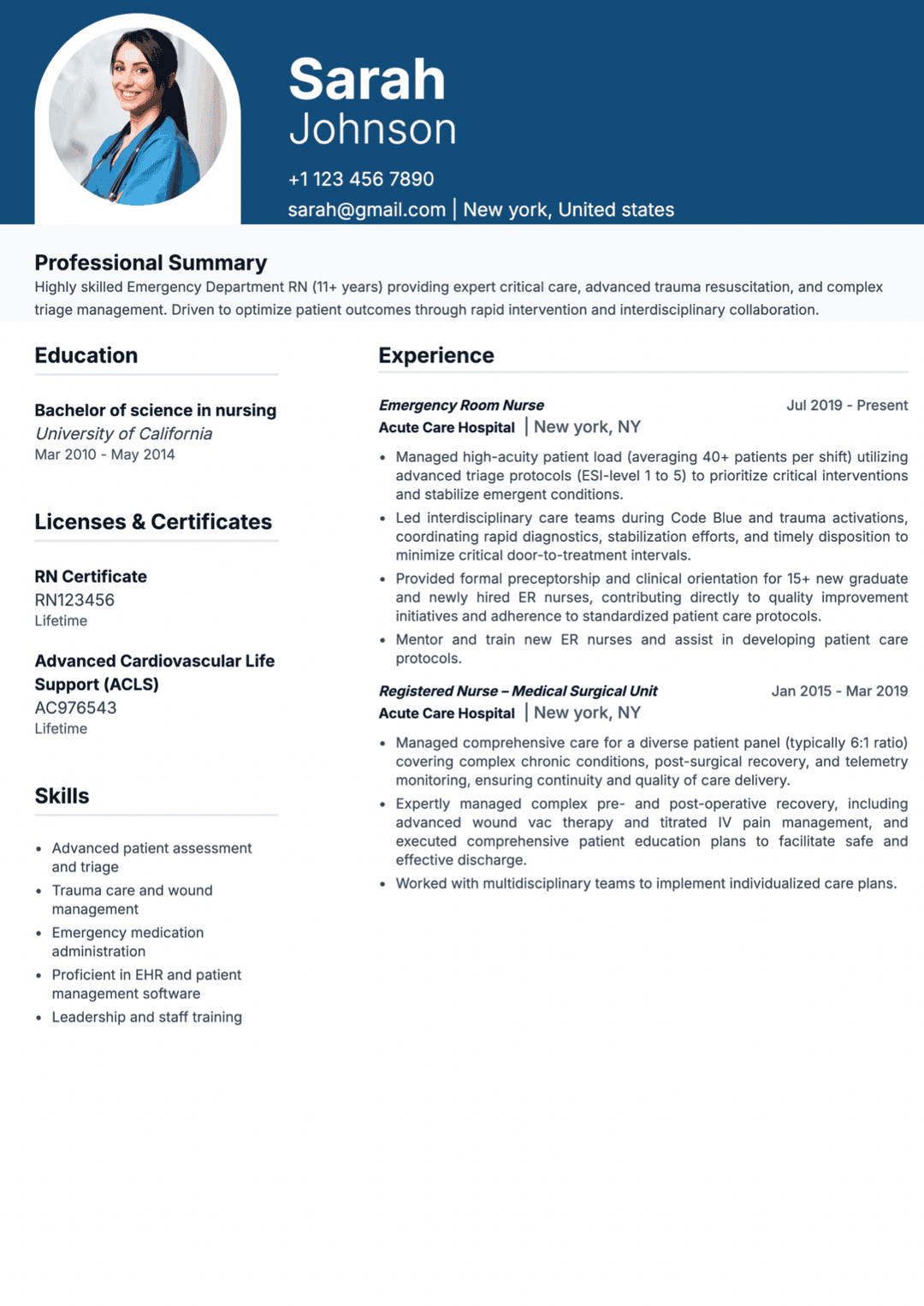 Use this template
Mid-level Experienced ER Resume
Best template for Emergency nurses with 5-10 years of experience.
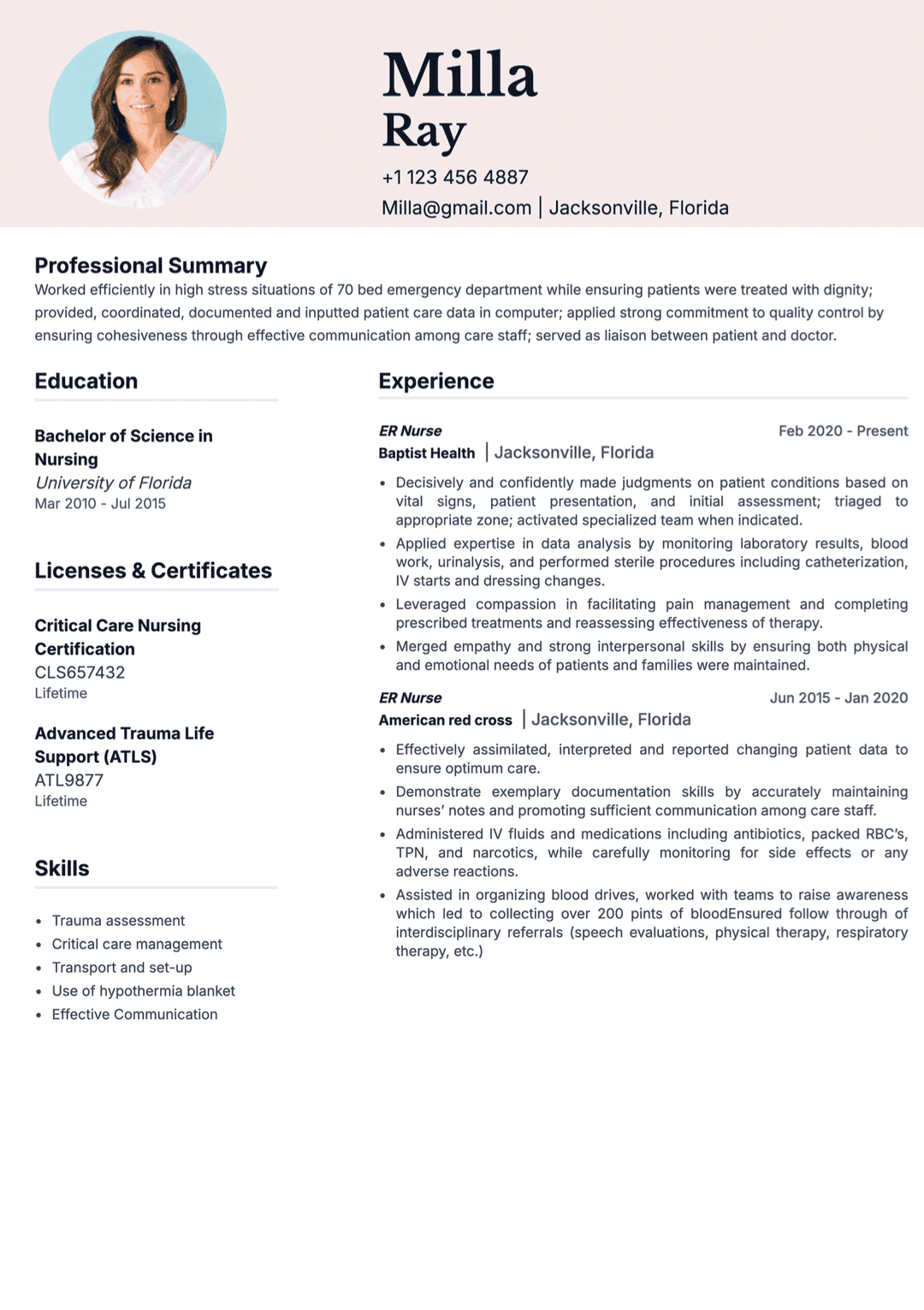 Use this template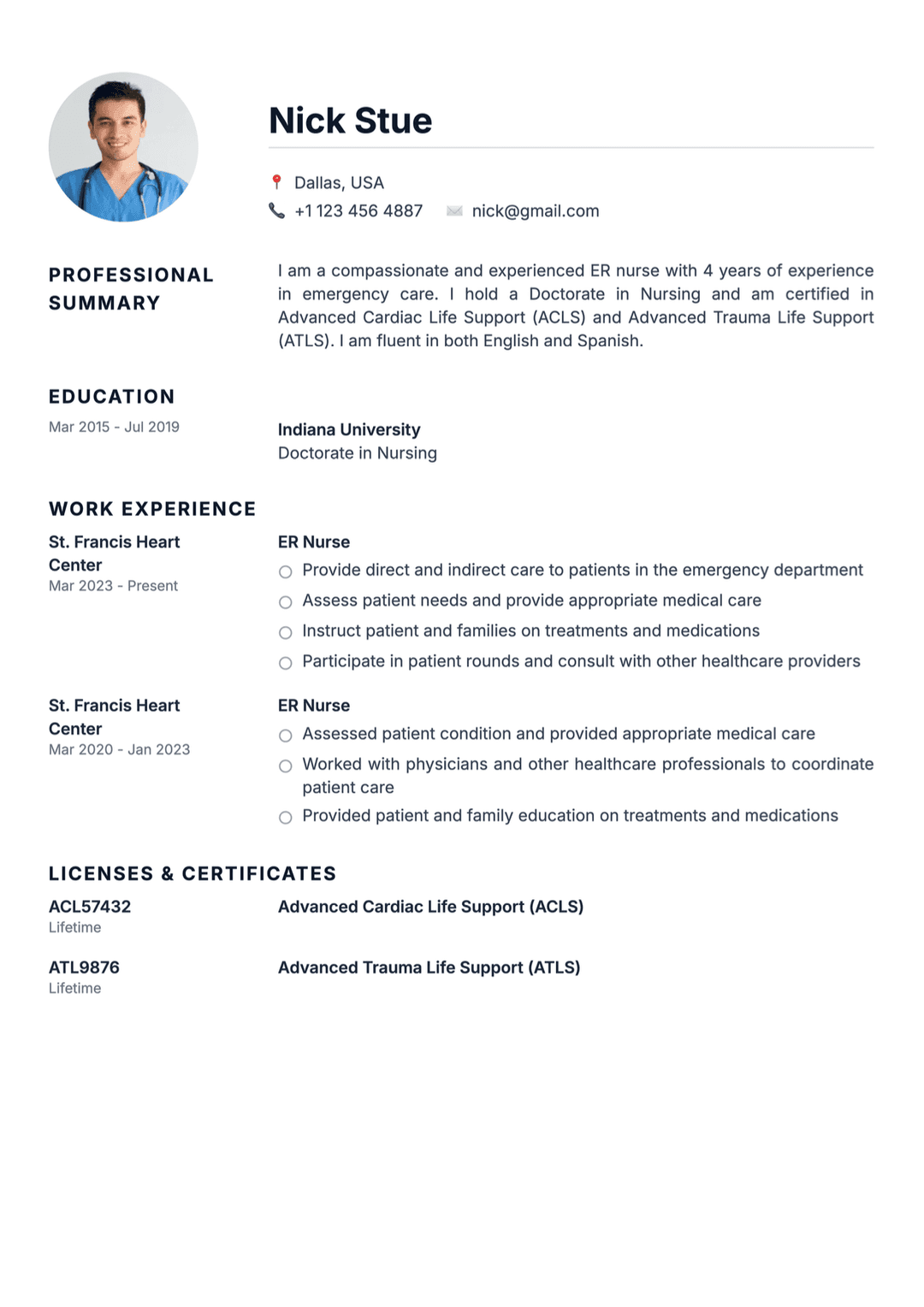
What Employers Want in Emergency Room Nurses Resume
- Certifications.
- Emergency and trauma care experience.
- Triage and rapid assessment skills.
- Critical thinking and Crisis De-escalation.
- Multitasking ability.
Hiring managers aren't looking for a "good nurse"; they are looking for a high-speed stabilizer who won't buckle when the waiting room is 40 people deep and a trauma is rolling in.
Build Emergency Nurse Resume with our AI-powered resume builder.
Get AI-crafted summary and bullet points with emergency nurse specific resume templates.
Your emergency room nurse resume would typically be scanned for Certifications, Evidence of "Clinical Flow", Specialized Procedural Skills and Soft Skills.
Here are some points which will help your resume to stand out:
- Certifications like - ACLS & BLS, PALS / ENPC, TNCC / ATCN and others.
- Emergency and trauma care experience - Explain throughput, Acuity Level, Patient Volume, Nurse to patient Ratios and Wait Times.
- Triage and rapid assessment skills - Identify the "sickest" patient in a crowd (ESI Leveling), Resuscitation & Codes, Trauma Response and Tech Proficiency.
- Critical thinking and Crisis De-escalation: Vital for handling psych emergencies or aggressive family members.
- Multitasking ability with strong collaboration with physicians and care team.
How to list skills in ER Nurse Resume Example
The best way to showcase your skills is by using a clear, easy-to-read format. Here's how to list your Emergency Nurse skills on a resume:
- Highlight your technical skills. Emergency Nurses need to be well-versed in the use of medical equipment, so be sure to mention any experience you have with various machines and tools.
- Showcase your communication skills. Emergency Nurses must be able to effectively and quickly communicate with colleagues, patients, and families. List any relevant experience you have with communication and negotiation, such as working in a fast-paced environment or handling difficult conversations.
- Demonstrate your problem-solving capabilities. Emergency Nurses must be able to think on their feet and come up with creative solutions to complex situations. List any relevant experience you have with critical thinking and decision-making.
Below are some must have Emergency Nurse Resume skills:
- Triage Skills
- Emergency Response
- Cardiopulmonary Resuscitation (CPR)
- Critical Care Nursing
- Telemetry
- Wound Dressing
- Intravenous Therapy
- Medication Administration
- Patient Assessment
- Electronic Health Records (EHR)
- Life Support Systems Operation
- Cardiac Life Support
- Automated External Defibrillator (AED) Usage
- Blood Draws
- Pain Management
- Use of Emergency Medical Equipment
- Knowledge of Intubation Procedures
- Proficiency in using ventilation equipment
- Operating Resuscitation Equipment
- Surgical Assisting Skills
- Excellent patient care
- Knowledge of advanced medical equipment
- Patient assessments
- Disaster preparedness
- Medication administration
- Emergency procedures
- Vital signs monitoring
- Time management
- Clinical documentation
- Team collaboration
Clinical Experience (Sample ER Nurse Resume)
Emergency departments operate in fast-paced, unpredictable environments where patient acuity can change within seconds. ER nurse resumes must clearly show decisive action, prioritization, and teamwork under pressure.
Sample ER Nurse Resume - Clinical Experience Bullet Points
- Performed rapid triage assessments for high patient volumes, prioritizing care based on acuity, presenting symptoms, and emergency protocols to ensure timely treatment and patient safety.
- Assisted with emergency procedures and trauma care, including preparation of equipment, patient stabilization, and support during critical interventions in collaboration with physicians and trauma teams.
- Monitored vital signs, cardiac rhythms, and patient responses continuously, identifying changes in condition and escalating concerns promptly to support rapid clinical decision-making.
- Administered medications and IV therapies according to emergency care protocols, maintaining accuracy, safety, and compliance in high-stress situations.
- Collaborated closely with physicians, nurses, paramedics, and ancillary staff during critical events, including trauma activations and rapid response situations, to deliver coordinated emergency care.
- Documented assessments, interventions, and patient outcomes accurately using electronic health record systems to ensure continuity of care and regulatory compliance.
How to write a summary emergency room nurse resume.
A resume summary statement is an effective tool for contextualizing the facts and data found in your ER nurse resume. These personal statements aim to construct a concise narrative clarifying your nursing experience, career trajectory, and future goals.
A summary statement focuses on your past nursing experiences to demonstrate a substantial background of transferable skills and knowledge. In contrast, an objective statement describes future career goals to illustrate how they correspond with the job opportunity.
Follow these best practices when writing either a resume summary or an objective:
- Tailor the statement to the specific ER nurse job you're applying for by emphasizing keyword skills and experiences from the job description.
- Reflect your goals, ambitions, values and personality.
- Start sentences with action verbs to make your summary dynamic and impactful.
- Be brief. A summary should only be 3-5 sentences
ER Resume Summary Example:
1. Experienced ER Nurse
CCRN with 8+ years experience in emergency medicine seeking an ER position. Passionate for emergency care and a proven track record of delivering exceptional patient outcomes in fast-paced environments. I am eager to leverage my proven skills in triaging urgent patients, communicating effectively with patients and families, and delivering compassionate care to provide optimal healthcare in critical situations.
Dynamic and highly motivated Emergency Nurse with 5+ years of experience providing compassionate care for patients in emergency and trauma care settings. Dedicated to delivering excellent quality of care and providing the highest level of patient service. Possess a strong background in patient assessments and triage.
2. Recent graduate ER Nurse
Passionate about providing excellent care to patients in emergency medical settings. Experienced in medical terminology, administrative tasks and patient-care protocols. Excellent communication skills with a commitment to creating and nurturing patient relationships.
Resilient and fast-acting BSN graduate with a natural aptitude for maintaining composure in high-stakes environments. I value clinical integrity and unyielding patient advocacy, aiming to master emergency nursing within a high-speed team that prioritizes life-saving precision and continuous professional growth.
Adaptable healthcare professional transitioning into the ED with a steadfast belief in the power of human-centered care during moments of crisis. I value efficiency and team collaboration in the face of uncertainty, with the goal of bridging the gap between clinical urgency and empathetic support for vulnerable patients.
Proactive, certification-heavy Registered Nurse (ACLS/TNCC) dedicated to achieving clinical excellence in trauma and emergency interventions. My approach is rooted in the values of patient safety and evidence-based precision, with the long-term goal of becoming a high-impact trauma responder on the hospital's front line.
Include Relevant Certifications and Training in ER Resume
Certifications are important for an emergency room nurse because they show you have the skills needed to handle tough and fast-paced situations. They help prove that you know how to care for patients in emergencies and can make quick, smart decisions.
Having certifications can also set you apart from others applying for the same job. These credentials show you're committed to learning and staying up to date with medical practices. Beneficial certifications for an ER nurse include:
- Advanced Cardiovascular Life Support (ACLS)
- Pediatric Advanced Life Support (PALS)
- Trauma Nursing Core Course (TNCC)
- Certified Emergency Nurse (CEN)
- Basic Life Support (BLS)
Listing these certifications in a special certifications section on your resume makes it easy for employers to see your qualifications at a glance. This can support your education details and give them confidence that you're ready for the challenges of the ER.
How to format Strong Emergency Nurse Resume
Understanding the role of Applicant Tracking Systems (ATS) is critical when formatting your ER nurse resume. ATS analyzes text on resumes, looking for precise keywords or phrases corresponding to desirable skills and qualifications for a particular position.
Employers use these systems to quickly sort and prioritize resumes to view the most qualified candidates. ATS-optimized formatting facilitates ATS's ability to recognize and parse information from your resume accurately.
Sometimes, something as small as a messy layout can bury a great candidate's potential. A truly effective resume doesn't just list your history; it presents your story in a way that is clean, professional, and most importantly - easy to scan in seconds.
Recommended ER Resume Template
The most effective nurse resume format is reverse-chronological:
- Header (Name, credentials, location, contact info)
- Professional summary
- Clinical experience (in reverse-chronological order)
- Licensure & certifications
- Education
- Skills (hard + soft)
Here are some formatting best practices:
- Fonts - Select ATS-friendly fonts matching the overall style of your resume. Some ATS-friendly fonts are Calibri, Arial, and Times New Roman. However, by employing these overused fonts, you may miss a chance to make your resume stand out. For interesting, modern font options with excellent readability, try Rubik, Lato, Montserrat, Raleway, Exo 2, or Volkhov, all available on the Enhancv Resume Builder.
- Document Type - Doc or PDF files are typical for resumes and most easily analyzed by ATS.
- Creative Elements in Text - Avoid using nonessential stylistic features within text. Elements such as emojis and non-standard date formats can impede ATS's ability to recognize information in these sections.
- Headings and Subheadings - Ensure resume sections are logically organized and include simple, precise headings. Standard section titles ensure ATS accurately recognizes and extracts information from these sections.
Common Mistakes to Avoid in ER Nurses Resume
Sometimes, something as small as a messy layout can bury a great candidate's potential. A truly effective resume doesn't just list your history; it presents your story in a way that is clean, professional, and most importantly - easy to scan in seconds.
Avoid these errors that might weaken many emergency nurse resumes:
- Writing generic nursing summaries - Summary is the first thing your hiring manager will read and it has to be on point, convey that you are a great fit and you have what it takes. So include job title specific skills and readiness in the summary rather than writing a generic ones. Many chatGPTs written summary are generic and they can never highlight your personality in those 4 lines. As only you can do it.
- Including irrelevant experiences - Mentioning your bartending summer job is a distraction from your nursing credentials. Unless these roles highlight specific transferable skills like leadership or crisis management, it is better to prioritize clinical rotations and nursing-related work to keep the recruiter's attention on your medical expertise.
- Failing to highlight emergency-specific experience - Avoid writing vague points and generic nurse experience if you have emergency specific experience in the past. Use numbers/percentage/ratios to provide evidence of your impact and competence.
- Overloading skills without context - Listing irrelevant skills or outdated technical skills or personal hobbies wastes valuable space on a nurse resume. Focus strictly on clinical competencies, high-acuity technical skills, and EMR proficiencies that are directly relevant to the unit where you are applying.
- Ignoring ATS-friendly formatting - Using complex headers, footers, or tables can scramble your data when it is uploaded into a hospital's hiring system. Stick to a simple, single-column structure to ensure your contact information and work history are accurately captured by the software.
- Ignoring ATS keywords - Read the job description and make sure to include nuances of the job description for your job role.
- Using the same resume for every job - Uploading a generic resume for different jobs like, using an ICU-focused resume for a Pediatrics role, this signals a lack of intentionality.
- Not using professional Nurse Resume Builder - Generic resume templates often lack the specialized sections required for nurses; such as license numbers, clinical rotations or specific nursing certifications. Plus they lack the design which would impress a nurse manager.
Using a nurse-specific builder ensures your nurse resume follows the structural patterns hospital recruiters expect and prioritize.